
Giant’s Causeway
Bushmills, United Kingdom
Story
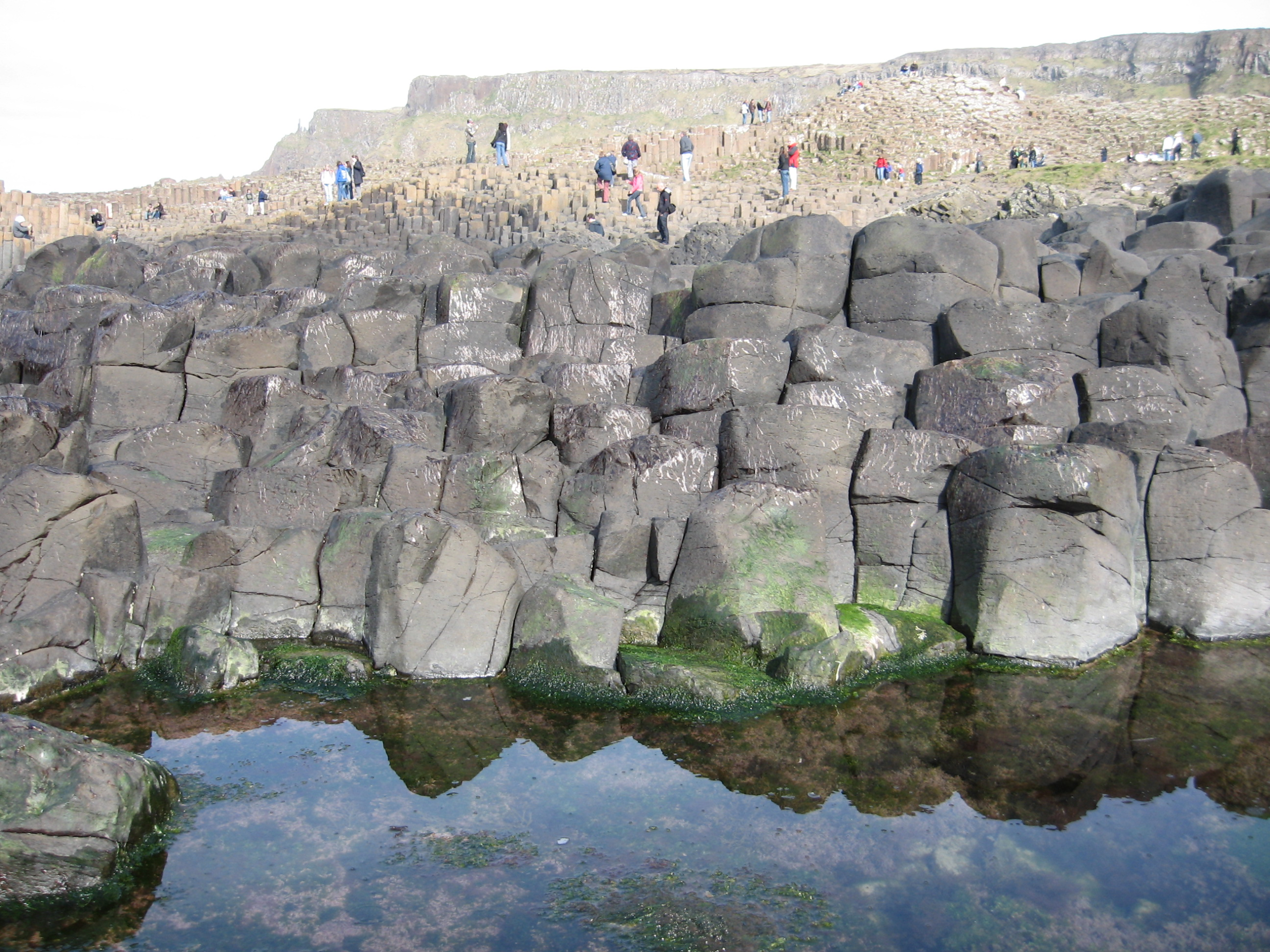
The Giant's Causeway is not mysterious once you understand the physics. Around 50 to 60 million years ago, during the Paleocene Epoch, molten basalt flooded across what is now County Antrim and began to cool. Cooling lava contracts, and contraction cracks — the same way drying mud cracks into polygons, only here the cracks propagated downward through dozens of feet of rock, slowly and evenly enough to produce columns with flat, interlocking faces. Most are hexagonal, because that geometry resolves tensile stress most efficiently. The result: approximately 40,000 columns, fitted together so tightly that the joints look machined.
Dublin artist Susanna Drury painted the site in 1739, won the first award ever presented by the Royal Dublin Society in 1740, and her watercolours were engraved and distributed across Europe. By 1765, an entry appeared in the French Encyclopédie, where geologist Nicolas Desmarest used the engravings to argue — for the first time in print — that basalt columns were volcanic in origin. The causeway helped settle a foundational argument in earth science.
The legend attached to it is older and stranger: that the Irish giant Fionn mac Cumhaill built the causeway as a bridge to fight the Scottish giant Benandonner, then — realising his rival was far larger — let his wife Sadhbh disguise him as a baby in a cradle. Benandonner saw the "infant" and fled back to Scotland in terror, destroying the causeway behind him. Across the North Channel, identical columns rise at Fingal's Cave on the Isle of Staffa — the same ancient lava flow, split by sixty million years of sea. The story may have grown to explain what people could see on both shores and couldn't otherwise connect.
What to Spot
The "ball and socket" joints between column segments — where the convex dome of one basalt tier fits into a concave hollow on the surface of the column below it, visible at the broken horizontal fractures throughout the formation.
Bonus Finds
- The formation known as the Organ — a vertical rank of tall, tightly packed columns rising in graduated heights against the cliff face, resembling the pipes of a pipe organ.
- The Giant's Boot, a single weathered basalt formation shaped convincingly like a large boot, sitting among the columns near the cliff base.
- Columns with sides other than six — four-, five-, seven-, and eight-sided columns appear throughout the formation, findable by counting the faces on individual pillars at the water's edge.
Share your finds and tag us — @scavtopia.
Plan your visit
Scavtopia turns this place — and any place — into an adventure. Join the waitlist.
Photo: Public domain