
Fly Geyser
Gerlach, Nevada
Story
Fly Geyser didn't erupt from the earth on its own terms. A geothermal energy company drilled here in 1964, found water that wasn't hot enough to be commercially useful, and walked away. The seal on the capped well failed. What grew in the decades that followed is one of the strangest-looking objects in North America — not discovered, but accidentally manufactured.
The mound now stands 25 to 30 feet tall, built entirely from dissolved minerals — calcium carbonate and silica — deposited by water that exits at over 200°F and never stops. Geologist Carolina Muñoz Saez, hired by the Burning Man Project after it purchased the 3,800-acre Fly Ranch in June 2016 for $6.5 million, found quartz forming inside the geyser at a rate that normally takes 10,000 years. The geyser is, in her words, unlike any other she has studied.
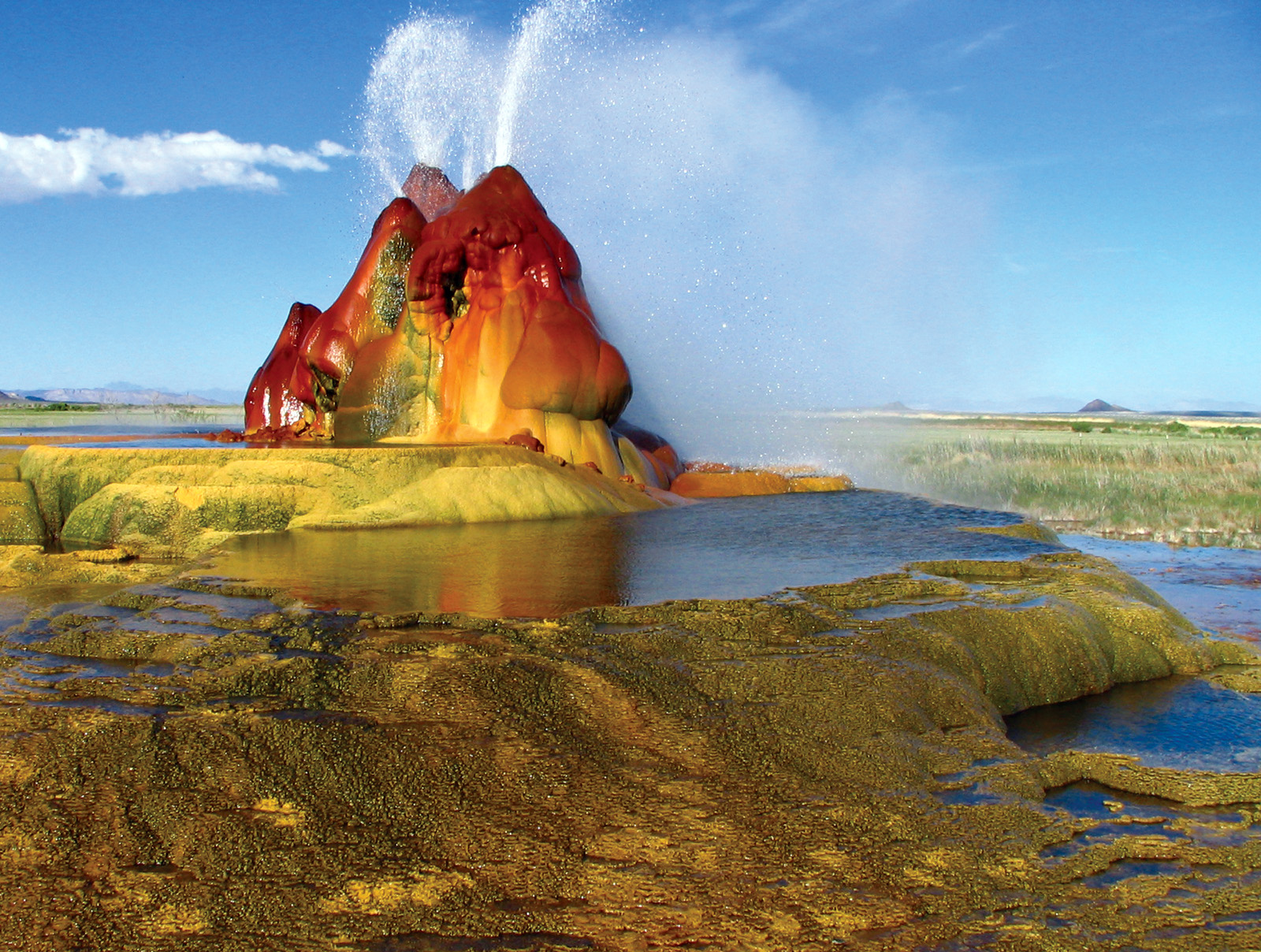
The color is the other thing. Thermophilic algae — organisms that thrive in scalding, mineral-saturated water — coat the cone and its travertine terraces in layers of deep green and burnt red. The palette reads almost biological, like something breathing. Water jets continuously from multiple conic openings, reaching 5 feet into the desert air, feeding 30 to 40 mineral pools spread across 74 acres. A failed industrial well became, over 60 years, something that looks like it came from another planet — though it is emphatically, volcanically of this one.
A short distance away, a calcium carbonate pillar about 12 feet tall marks the site of an earlier 1916 well — the first geyser on the property, which dried up entirely when the 1964 drilling released enough pressure to redirect the flow. The Burning Man Project opened Fly Ranch to small, guided public walks in May 2018. Access is seasonal and limited.
What to Spot
The abandoned 1916 calcium carbonate cone — a pale, roughly 12-foot pillar standing near the active geyser mound — formed when the first well was drilled and went quiet once the 1964 well stole its pressure.
Bonus Finds
- The travertine terraces fanning out from the geyser base, where mineral-rich overflow has built shallow, stepped pools stained in greens and reds across a 74-acre field — each one still forming.
- The multiple conic openings at the top of the active mound, each ejecting water simultaneously — a result of the failed seal that turned a single capped borehole into a permanently erupting, multi-vented structure.
- The color gradient on the mound itself, where the algae shifts visibly from deep emerald at the water-soaked base to rust-orange near the drier upper edges — a live map of moisture and heat.
Share your finds and tag us — @scavtopia.
Plan your visit
Scavtopia turns this place — and any place — into an adventure. Join the waitlist.
Photo: Jeremy C. Munns / Public domain