
Watts Towers
Los Angeles
Story
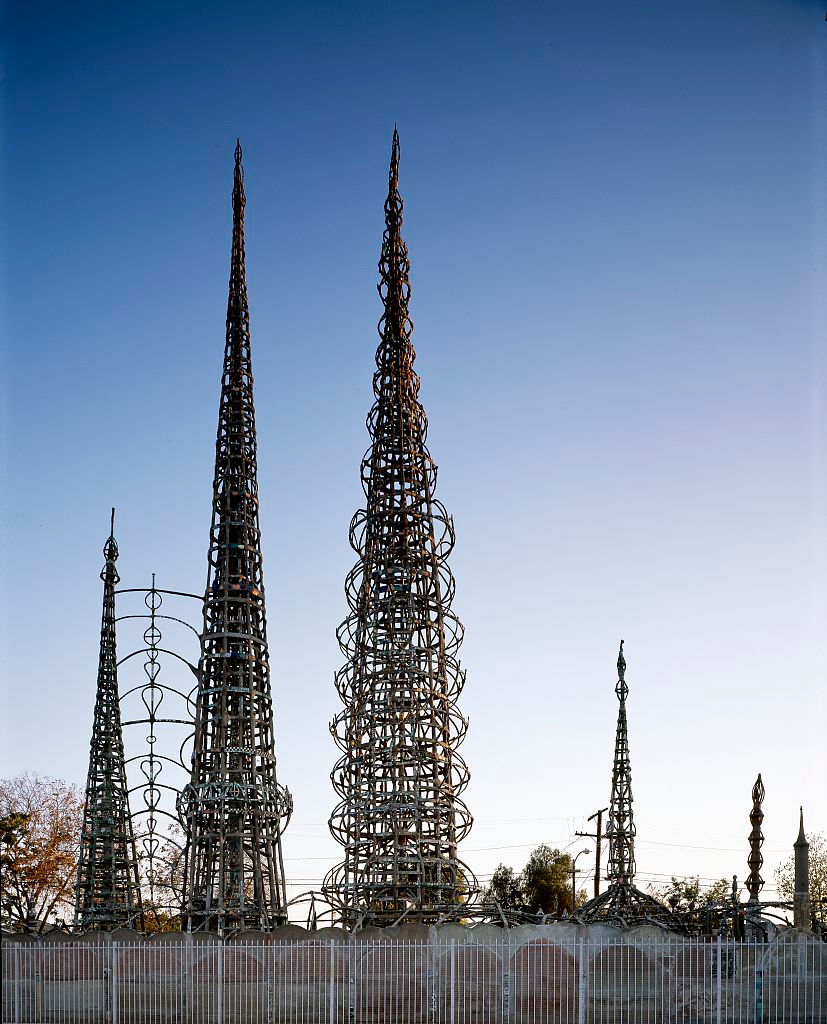
Sabato Rodia never explained himself. The Italian tile mason who settled in Watts in 1920 spent 33 years — from 1921 to 1954 — building seventeen interconnected towers on his residential lot using no blueprints, no scaffold, no power tools, and no crew. Just rebar, wire mesh, his own concrete mixture, and whatever he could carry home: Malibu Potteries fragments, seashells, milk of magnesia bottles, green 7 Up and Squirt glass, broken crockery pressed into surfaces by the handful. He called it Nuestro Pueblo — our town. Then in 1955, tired of permit battles with the City of Los Angeles and worn down by years of vandalism, he signed the property over to a neighbor and left for Martinez, California. He never came back.
The tallest tower reaches 99.5 feet — taller than any unreinforced concrete structure of its kind — built by one man bending scrap rebar against railroad tracks. After Rodia left, the city condemned the site and ordered it demolished. Actor Nicholas King and film editor William Cartwright bought the property in 1959 for $2,000 and rallied architects, artists, and community members into the Committee for Simon Rodia's Towers in Watts. On October 10, 1959, engineers applied 10,000 pounds of lateral force to the main tower. It held.
What Rodia built alone, with cast-off material and no formal training, survived every test the city could devise — and then survived the 1994 Northridge earthquake too, losing only a few tile chips. The towers are not ruins. They are an argument, still standing.
What to Spot
Embedded in the mosaic surfaces of the towers, recognizable mid-century soft drink bottles — some still showing the raised lettering of 7 Up, Squirt, Bubble Up, and Canada Dry logos — pressed whole or in fragment into the concrete.
Bonus Finds
- The pavement inside the enclosure is itself a mosaic — pressed tile shards, shells, and glass set into the ground underfoot, continuous with the towers above, so the entire site reads as a single embedded composition rather than objects standing on neutral ground.
- Rodia bent much of the framework using nearby railroad tracks as a makeshift vise, walking the Pacific Electric Railway right-of-way nearly 20 miles to Wilmington to scavenge material — the towers' armatures are essentially the infrastructure of the railway, repurposed and pointed skyward.
- The tower forms closely echo the gigli, the tall processional 'lily' structures carried through the streets of Nola, Italy during the annual Festival of St. Paulinus — a detail Rodia never mentioned publicly, but the resemblance to that tradition from his home region is difficult to read as coincidence.
- California Historic Landmark Marker No. 993 is mounted on site — its text describes Rodia as spending '30 years' on the towers, a small discrepancy from the documented 33-year span, quietly embedded in the official record.
Share your finds and tag us — @scavtopia.
Sightings
- Beneath the Underdog (book, 1971) — Charles Mingus wrote about his childhood fascination with Rodia and the towers in his autobiography, one of the earliest accounts of the site's hold on the Watts community
Plan your visit
Scavtopia turns this place — and any place — into an adventure. Join the waitlist.
Photo: Carol M. Highsmith / Public domain