
Venice Canals
Los Angeles
Story
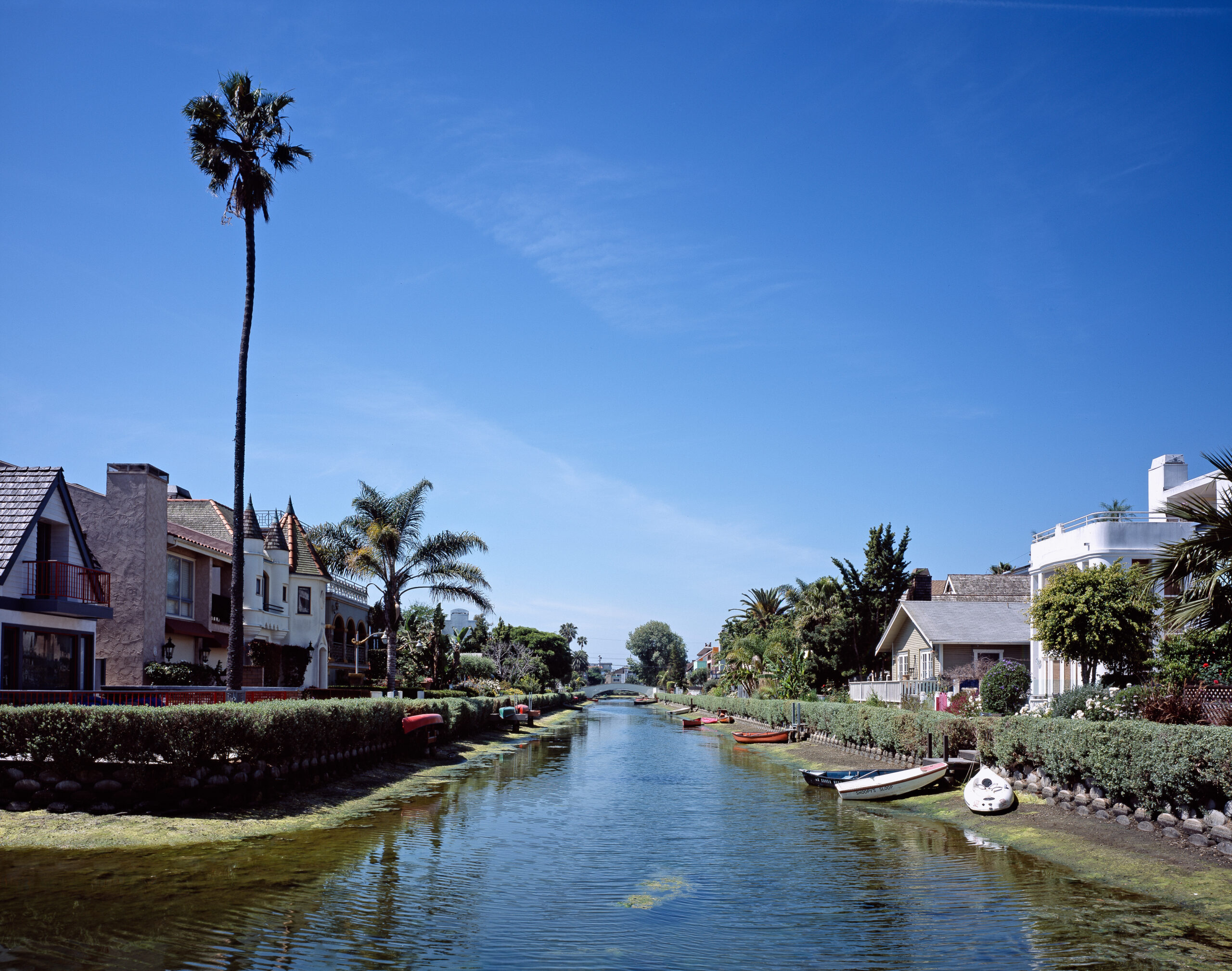
Most of the canals Abbot Kinney built in 1905 no longer exist. The city of Los Angeles paved them over in 1929 — turning waterways into roads, erasing the most literal part of his Venice of America experiment. What survived is six short canals tucked into a residential grid just blocks from the Pacific, declared a Historic District in 1982 and still largely unchanged in character. Kinney, a tobacco heir who made his fortune before turning to real estate utopianism, wanted to transplant the atmosphere of Venice, Italy to coastal Los Angeles. He built gondolas, imported gondoliers, and named his streets after Italian cities. The canals themselves he named differently — after stars. Aldebaran, Altair, Venus. Celestial names for man-made water in a desert city. What's counterintuitive about the Venice Canals today isn't that they survived. It's how ordinary they feel — wooden footbridges, resident ducks, houses close enough to touch across the water. The grandeur Kinney imagined has long since been replaced by something quieter and stranger: a functional neighborhood that happens to be threaded with canals, where morning light hits the water between bungalows and the whole thing reads less like a theme park ghost than a legitimate accident of geography. The paving of 1929 saved these six by concentrating investment in the ones that remained. Neglect, then protection. Los Angeles has a habit of preserving things sideways.
What to Spot
The cast-iron street signs at canal intersections bear both the canal name and the star or celestial body it was named after — small, weathered plates that most visitors walk past without registering the astronomical logic Kinney embedded in the street grid.
Bonus Finds
- The wooden pedestrian footbridges spanning the canals are low and close to the waterline — close enough that their reflections form near-complete arches, doubling the bridge in still water on calm mornings.
- Grand Canal runs the longest of the six surviving waterways, and at its quieter northern end the houses back directly onto the water with small private docks — an arrangement that looks borrowed from the Netherlands rather than from Italy.
- The surrounding street names — Windward Avenue, Abbot Kinney Boulevard — mark the skeleton of a much larger vision; the boulevard itself was renamed in Kinney's honor in 1989, nearly sixty years after his death in 1920.
Share your finds and tag us — @scavtopia.
Plan your visit
Scavtopia turns this place — and any place — into an adventure. Join the waitlist.
Photo: Carol M. Highsmith / Public domain