
Union Station
Chicago
Story
Chicago Union Station opened on May 16, 1925, and most people pass through it like a corridor — heads down, bags rolling, eyes on the departures board. That's the wrong way to enter the Great Hall.
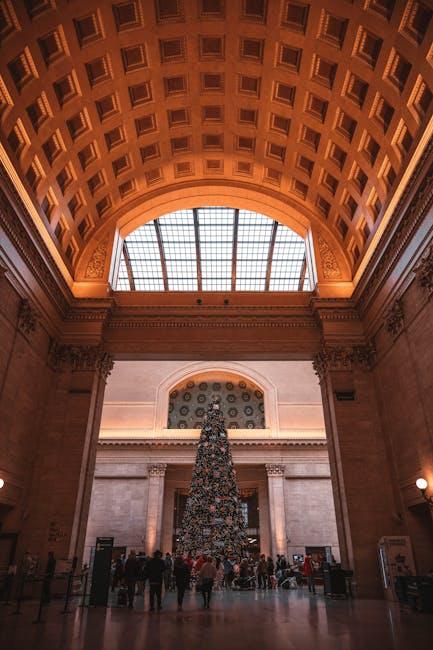
Daniel Burnham drew the original concept, but he died in 1912, thirteen years before the station opened. The firm Graham, Anderson, Probst & White carried the project to completion, and what they built is one of the great interior spaces in American civic architecture — a barrel-vaulted waiting room roughly 220 feet long and 112 feet high, ringed by 84-foot Corinthian columns and capped by a continuous skylight that floods the room in a particular quality of light you don't find anywhere else in Chicago.
The station served the Pennsylvania Railroad, the Burlington Route, the Milwaukee Road, and the Chicago & North Western at its peak — millions of passengers a year, soldiers shipping out during the Second World War, emigrants heading west. The original design included a matching concourse building across Canal Street; that structure was demolished in 1969 to make way for an office tower, leaving the Great Hall as a surviving fragment of a grander vision that was never fully realized.
What strikes visitors who actually stop is the quality of the silence inside the Hall — a functional train station operating on that scale, and yet the room absorbs sound in a way that feels improbable. The architects understood that the building's job was not just to move people but to mark the moment of departure as something worth feeling.
What to Spot
The Great Hall's barrel-vaulted ceiling carries a long central skylight flanked by rows of coffered panels, and at certain hours the light it casts throws perfectly clean rectangular shadows down the length of the columns — the geometry of the room made briefly visible on its own walls.
Bonus Finds
- The eight Corinthian columns lining each side of the Great Hall stand 84 feet tall — each one monolithic enough that the human scale of the room only registers fully when another person is standing at the base.
- The Canal Street facade is deliberately understated: a long limestone exterior with minimal ornament that gives almost no hint of the vaulted space behind it, a deliberate choice by the architects to concentrate the drama inward.
- A brass plaque near the main entrance commemorates the station's listing on the National Register of Historic Places in 2002 — decades after the demolition of its companion concourse building made preservation suddenly urgent.
Share your finds and tag us — @scavtopia.
Sightings
- The Untouchables (1987) — Brian De Palma staged the film's climactic baby-carriage sequence on the Great Hall's Grand Staircase, making the station's limestone steps one of the most recognizable locations in 1980s American cinema
Plan your visit
Scavtopia turns this place — and any place — into an adventure. Join the waitlist.
Photo: Quang Vuong / Pexels / Pexels license