
Scotty’s Castle
Death Valley
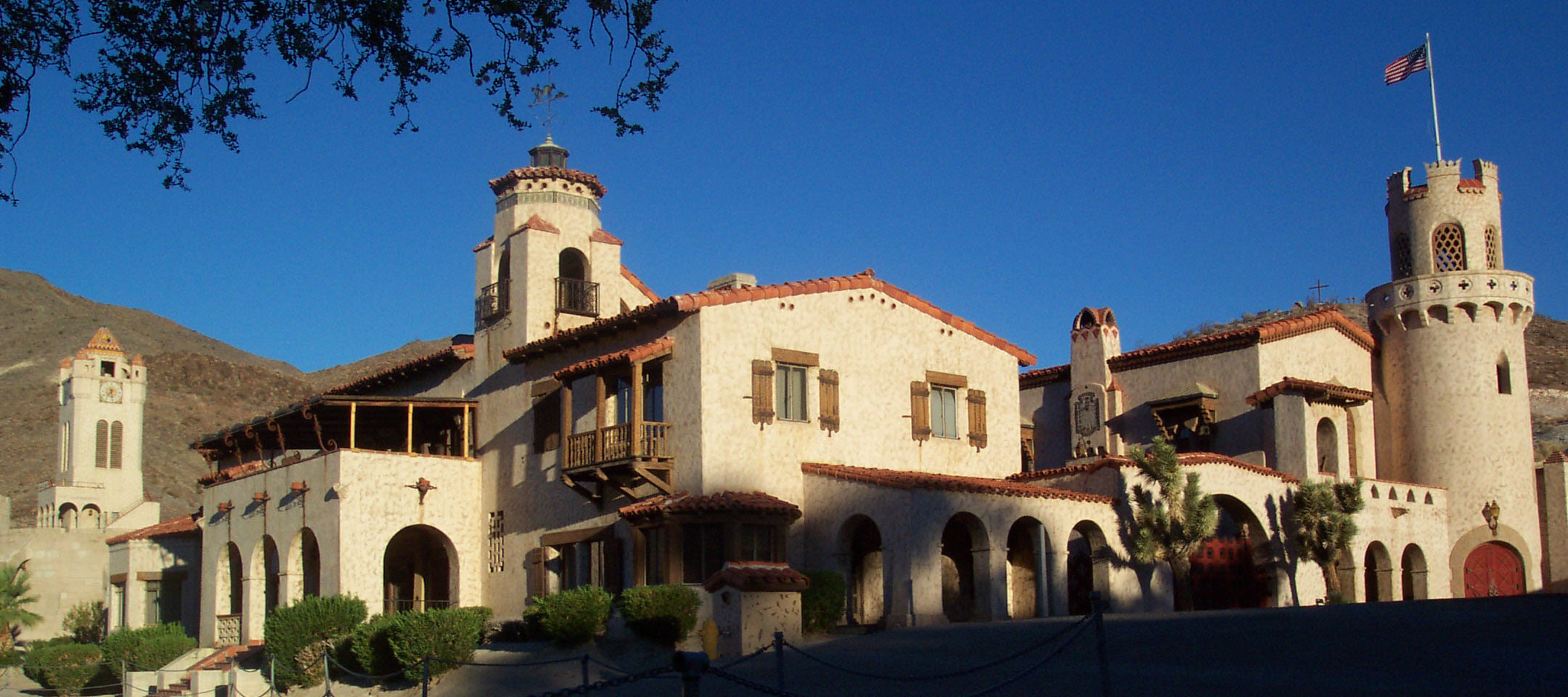
Story
Everyone calls it Scotty's Castle. Walter Scott never owned it, never built it, and never paid for a single nail. The villa in the Grapevine Mountains belonged entirely to Albert Mussey Johnson, a Chicago millionaire who Scott had conned into funding a nonexistent gold mine — and who, remarkably, forgave him for it. The two became genuine friends, and Johnson kept building anyway.
Construction began in 1922 under architect Martin de Dubovay and designer Charles Alexander MacNeilledge. The Mission Revival and Spanish Colonial Revival structure cost somewhere between $1.5 and $2.5 million before the 1929 stock market crash drained Johnson's finances and stopped work cold. The villa never reached its intended scale — thousands of tiles for a planned swimming pool still sit unused in the tunnels beneath the building — but what exists is extraordinary: a full Welte theater organ with 1,121 pipes, a water fountain in the Great Hall where water dripped down a rock face for evaporative cooling, and a Pelton wheel turbine powered by canyon springs 300 feet above the house, generating the estate's electricity before the grid reached this corner of the desert.
Johnson died without heirs. He and his wife Bessie left the property to the Gospel Foundation, the charity he founded in 1946, and the National Park Service purchased it in 1970 for $850,000. Walter Scott, cared for by the Foundation after Johnson's death, died in 1954 and was buried on the hill above the house he made famous but never owned.
A flash flood on October 18, 2015, sent debris a foot deep into the visitor center and destroyed the access road. A fire on April 22, 2021, took the historic 1922 garage and workshop. The castle has been closed to general visitors since — though flood recovery tours have offered limited access to the grounds.
What to Spot
Walter Scott's grave marker on the hill overlooking the castle — a simple headstone set into the rocky slope above the main villa, visible from the grounds below.
Bonus Finds
- The 1930s solar water heater near the main house is substantially larger than any domestic solar installation of the era — a reminder that Johnson was engineering self-sufficiency in one of the most hostile climates in North America decades before it was fashionable.
- In the tunnels beneath the building, hundreds of nickel-iron battery cells line the walls — the backup power system that kept the lights on when the Pelton wheel couldn't keep pace. The scale of it reads less like a home and more like a small industrial plant.
- The Great Hall fountain, where water was channeled down a natural rock face into a catch basin, was both decoration and climate control — evaporative cooling dressed up as sculpture, elegant and practical in equal measure.
- A large stock of railroad ties salvaged from the Tonopah and Tidewater Railroad is visible on the property — repurposed infrastructure from a rail line that once connected the desert's mining economy and is now gone entirely.
Share your finds and tag us — @scavtopia.
Plan your visit
Scavtopia turns this place — and any place — into an adventure. Join the waitlist.
Photo: Public domain