
Santa Maria del Fiore
Florence, Italy
Story
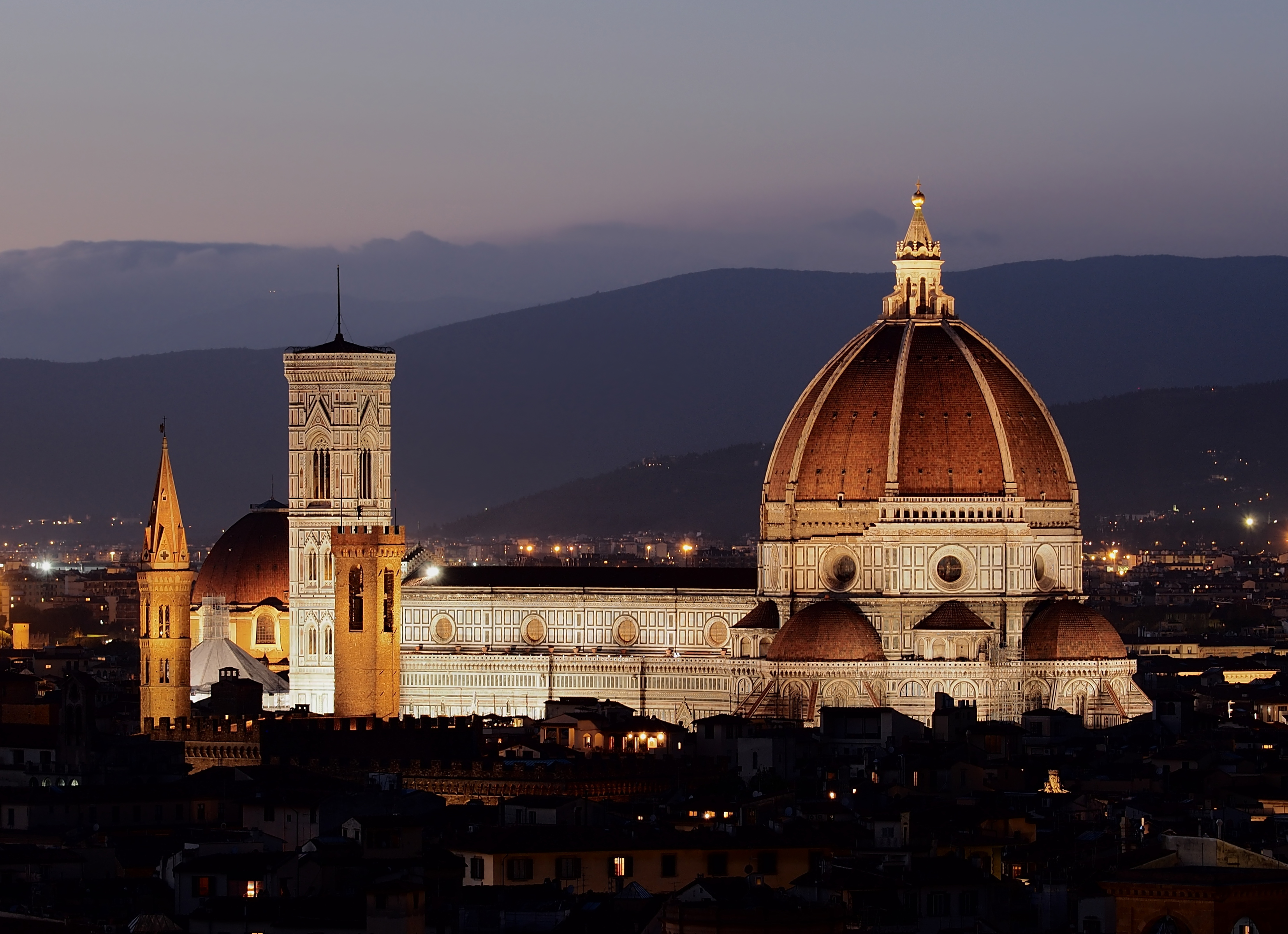
Everyone comes for the dome. That's the trap. Brunelleschi's cupola — the one that changed architecture — is so dominant that most visitors spend their entire visit tilting their necks upward, missing what's directly beneath their feet.
In 1436, after 140 years of construction, Pope Eugenius IV consecrated Santa Maria del Fiore. Brunelleschi had solved the impossible: an octagonal dome 143 feet wide with no centering scaffolding, using a double-shell brick technique he kept deliberately secretive. The engineering alone fills shelves of scholarship. But inside the cathedral, set into the marble floor of the left nave, something quieter has been waiting since 1475.
Paolo dal Pozzo Toscanelli, a Florentine physician, astronomer, and close friend of Brunelleschi, designed a gnomon — a solar calendar instrument — by cutting a small bronze hole into the lantern of the dome some 300 feet overhead. On the summer solstice each year, a disc of sunlight falls through that hole and travels slowly across a graduated marble line inlaid in the floor below. When the light hits the precise meridian marker, it confirms the date of the solstice to within seconds. The cathedral itself becomes the instrument.
Toscanelli's meridian line was one of the most accurate solar measurements in Europe at the time. The same man corresponded with Christopher Columbus about Atlantic navigation, sharing geographical calculations that may have contributed to Columbus's 1492 voyage. The line on the floor is a small bronze strip, easy to pass without a second glance. It runs near the base of a pillar, unremarkable in isolation — until you understand that sunlight has been landing on it, on schedule, for over five centuries.
What to Spot
A thin bronze meridian line inlaid in the marble floor of the left nave, marked with graduated divisions, positioned to catch a disc of sunlight cast down from a small hole in the dome's lantern on the summer solstice.
Bonus Finds
- The cathedral's famous 19th-century marble façade — white Carrara, green Prato serpentine, pink Maremma — looks medieval but was completed in 1887, designed by Emilio De Fabris after centuries of debate left the original façade unfinished and eventually demolished.
- Inside, Giorgio Vasari and Federico Zuccari's fresco cycle covering the dome's interior depicts the Last Judgment across 38,000 square feet — painted between 1572 and 1579 — and is intentionally overwhelming at this scale, a deliberate theological vertigo.
- Two equestrian frescoes on opposite walls of the nave, painted to resemble three-dimensional monuments, are early exercises in trompe-l'œil perspective: one depicts Sir John Hawkwood, a mercenary commander painted by Paolo Uccello in 1436; the other depicts Niccolò da Tolentino, painted by Andrea del Castagno in 1456.
- The Porta della Mandorla on the cathedral's north side contains a carved relief of the Assumption of the Virgin set within an almond-shaped mandorla — and the surrounding sculptural program includes early work attributed to a young Donatello, completed around 1406.
Share your finds and tag us — @scavtopia.
Sightings
- A Room with a View (1985) — James Ivory's adaptation opens in Florence with the cathedral as backdrop to Lucy Honeychurch's disorienting encounter with the city
- Hannibal (2001) — Ridley Scott used Florence locations including the Piazza del Duomo for scenes in which Hannibal Lecter operates as a museum curator
- Inferno (2016) — Ron Howard filmed chase sequences through and around the cathedral complex as Robert Langdon follows a trail through Dante's Florence
Plan your visit
Scavtopia turns this place — and any place — into an adventure. Join the waitlist.
Photo: Petar Milošević / CC BY-SA 4.0