
Palais Idéal du Facteur Cheval
Hauterives, France
Story
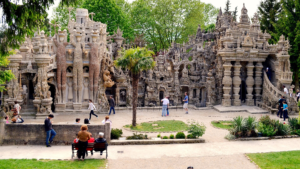
Ferdinand Cheval was a postman. Every day for 33 years, he walked 18 miles through the Drôme countryside delivering mail — and collecting stones. Not abstractly. He stuffed them in his pockets, then hauled them in a basket, then wheeled them home by barrow in the dark. The palace he built from them in Hauterives wasn't designed on paper. It grew from a dream he had in 1879, after tripping on a strangely shaped stone and pocketing it, and from the thousands of hours that followed before dawn and after dusk while his neighbors slept.
By 1912, the result was an architecture unlike anything a trained architect would — or could — produce: Hindu temples fused with medieval towers, a Swiss chalet colliding with a mosque, grottos stitched with shells and fossils, the whole mass rising from a garden in southeastern France like a fever made solid. André Malraux, then France's Minister of Cultural Affairs, classified it as a historic monument in 1969 — a rare honor for a building designed by no one with any credentials at all.
The Surrealists had already claimed Cheval as one of their own decades earlier, with André Breton writing admiringly of the palace in 1932. Cheval himself never sought their approval. He carved his own testimony directly into the walls, date by date, hour by hour — a man determined that no one would ever mistake what this had cost him.
What to Spot
The carved inscription on the facade recording Cheval's own accounting of the build: 10,000 days, 93,000 hours, 33 years of toil — chiseled into the stone in his own words, flanked by the dates 1879 and 1912.
Bonus Finds
- The east facade references Hindu temples, a medieval castle, and a mosque within the span of a few meters — architectural traditions from across the world collapsed into a single unbroken surface by a man who had never left France.
- Cheval embedded fossils and curiously shaped stones directly into the walls where he found them compelling — some protrude visibly, their original form intact within the surrounding concrete.
- Cheval was refused burial in the village cemetery and spent the last eight years of his life building his own mausoleum there instead; the tomb at the Hauterives cemetery, completed in 1922, carries many of the same carved inscriptions and motifs as the palace.
Share your finds and tag us — @scavtopia.
Sightings
- L'Incroyable Histoire du Facteur Cheval (2018) — Nils Tavernier's biopic with Jacques Gamblin reconstructed Cheval's 33-year build as its central subject
Plan your visit
Scavtopia turns this place — and any place — into an adventure. Join the waitlist.
Photo: Par Benoît Prieur / CC0 / Public domain