
Loretto Chapel
Santa Fe, New Mexico
Story
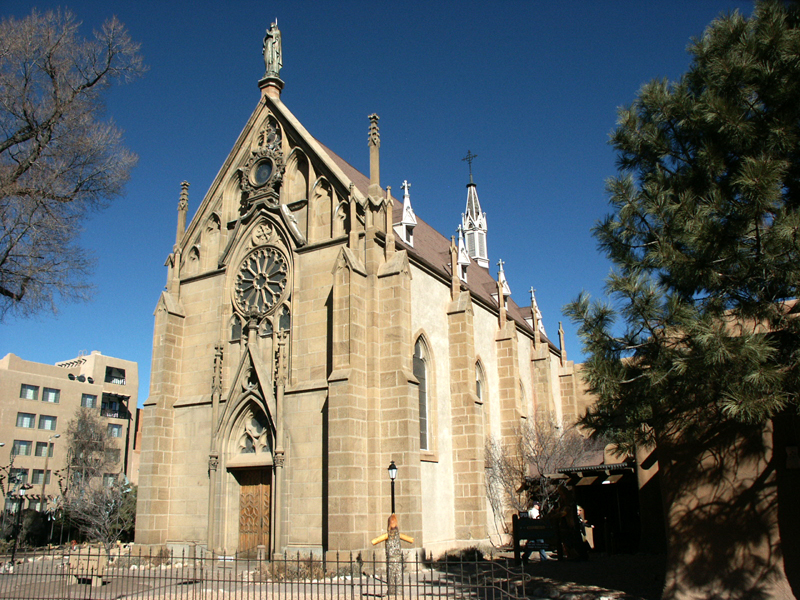
The Loretto Chapel is famous for its staircase. That's the problem — the fame front-loads the miracle and buries the craftsmanship. Completed in 1878 by architect Projectus Mouly, who modeled it on the Sainte-Chapelle in Paris, the chapel itself is a Gothic Revival building in sandstone, its spires and imported French stained glass arriving overland along the Santa Fe Trail. Mouly died unexpectedly in 1879, before he resolved one critical problem: no access to the choir loft. The space was too tight for a conventional staircase.
Sometime between 1877 and 1881, a craftsman built the solution now called the Miraculous Stair — a helix rising 20 feet through two full turns, 33 steps, no newel post, no central column, no nails, no glue. The inner stringer bends at such a tight radius that it functions, structurally, almost like the pole it replaces. The outer stringer is assembled from nine overlapping wood segments joined with pegs, forming a laminate stronger than the raw wood alone. The material is a species of spruce not native to New Mexico.
For a long time, the builder's identity was a genuine mystery. In the early 2000s, amateur historian Mary Jean Cook identified a likely candidate: François-Jean Rochas — known as "Frenchy" — a French-born rancher and occasional carpenter who arrived in New Mexico in the 1870s. A Santa Fe New Mexican obituary from 1895, written after Rochas was murdered, described him as "an expert worker in wood" who "build the handsome stair-case in the Loretto chapel." Cook also found an 1881 entry in the Sisters' logbook recording a $150 payment to Rochas for wood. The case is not closed, but it is closer than the legend suggests.
The handrails were added in 1887 by craftsman Phillip August Hesch. Before that, the staircase was reportedly so vertiginous that some nuns descended it on their hands and knees.
What to Spot
The helix staircase rising to the choir loft — two full 360-degree turns in wood, assembled without nails or glue, with no central pole visible at the core.
Bonus Finds
- The interior stained glass windows, imported from France and transported overland along the Santa Fe Trail in the 1870s, still sit in the chapel's Gothic lancet frames.
- The iron support bracket added to the staircase in 1887 — the same year as the handrails — is visible near the base, a later intervention that slightly dampens the staircase's natural spring-coil flex.
- The 33-step count of the staircase, equal to the traditional age of Christ at his death, is a detail the chapel itself points to — worth counting on the way up.
Share your finds and tag us — @scavtopia.
Plan your visit
Scavtopia turns this place — and any place — into an adventure. Join the waitlist.
Photo: User:Camerafiend / CC BY-SA 3.0