
Hollyhock House
Los Angeles
Story
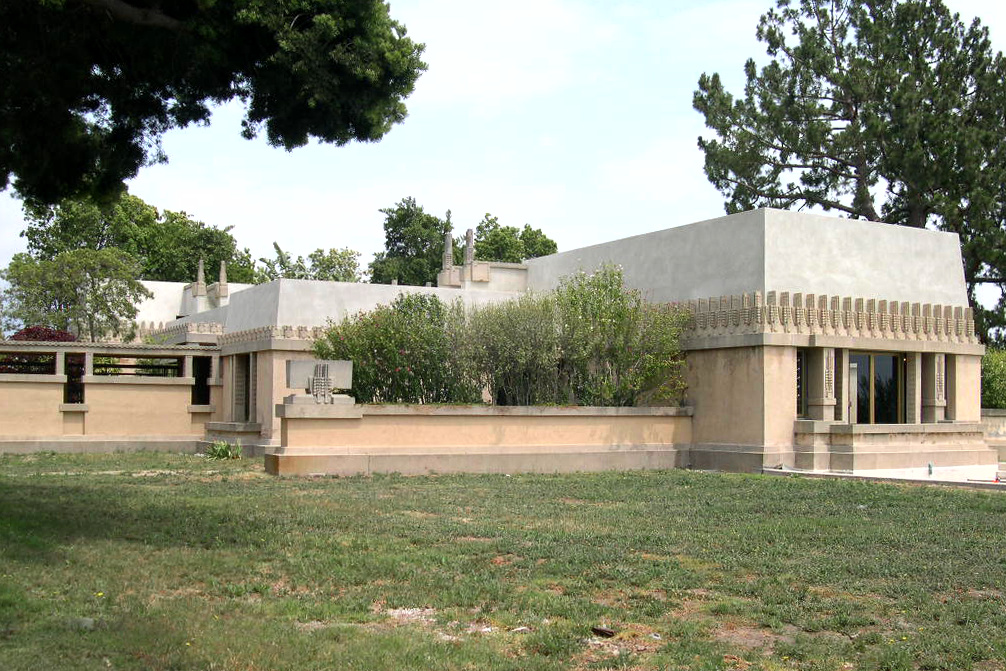
Frank Lloyd Wright designed dozens of houses, but Hollyhock House — completed in 1921 on a knoll called Olive Hill in East Hollywood — is the one that resists easy categorization. Wright himself called it the beginning of his California work, yet it belongs to no single style. Critics have reached for Mayan, Aztec, and Californian vernacular as labels; none quite fit. That slipperiness is part of the point.
Aline Barnsdall was an oil heiress from Pennsylvania who had spent years trying to build a live-theater complex. She first hired Wright in Chicago no later than early 1915, when he designed a building for the Chicago Little Theatre. By June 1919, she paid $300,000 to acquire the 36-acre Olive Hill site. What she got, eventually, was a house but not a theater — Wright was simultaneously designing Tokyo's Imperial Hotel, and construction supervision fell to his son Lloyd Wright and a young Rudolph Schindler, with Richard Neutra also contributing to the broader complex. The theater never materialized. The house did, surrounded by two guesthouses, a garage, terraces, and a spring house.
The design's signature gesture is the hollyhock: Barnsdall's favorite flower, abstracted into a geometric motif and pressed into nearly every surface — friezes, capitals, cast ornament, furniture. The abstraction is so complete that the flower becomes something closer to a cipher, and only once you've seen it clearly do you begin to find it everywhere. Barnsdall donated the main house to the city of Los Angeles on December 22, 1926; it is now a National Historic Landmark and Los Angeles's first World Heritage Site, part of the UNESCO designation "The 20th-Century Architecture of Frank Lloyd Wright." The building rewards patience. Most visitors move through it quickly. A few stop at the living room fireplace and stay a while.
What to Spot
The cast concrete fireplace surround in the living room, where a three-dimensional hollyhock-motif relief frames a shallow moat of water that wraps the hearth — fire and water sharing the same architectural moment.
Bonus Finds
- The exterior walls slope inward as they rise — a subtle batter that gives the house its vaguely fortified, pre-Columbian silhouette and catches afternoon light differently than any vertical wall would.
- The long entrance loggia that connects the outer terraces to the central courtyard creates a compression-and-release sequence: low ceiling, then open sky, then the courtyard basin — a spatial rhythm Wright returned to repeatedly in his later work.
- Barnsdall's friends Louise Arensberg and Walter Conrad Arensberg, significant early collectors of modernist and Dada art, moved into Residence A in 1923 — a detail that quietly links this hilltop compound to the same circle that championed Marcel Duchamp in America. [Flag for human fact-check: the Arensbergs' residency at Residence A and dates.]
- The hillside itself was an olive grove as late as the 1890s, planted by J. H. Spires on a 20-foot grid — and before Barnsdall arrived, Olive Hill hosted annual Easter services and the location shoot for D. W. Griffith's 1916 epic Intolerance.
Share your finds and tag us — @scavtopia.
Plan your visit
Scavtopia turns this place — and any place — into an adventure. Join the waitlist.
Photo: Sfoskett / CC BY-SA 3.0