
Great Wall of Los Angeles
Los Angeles, California
Story
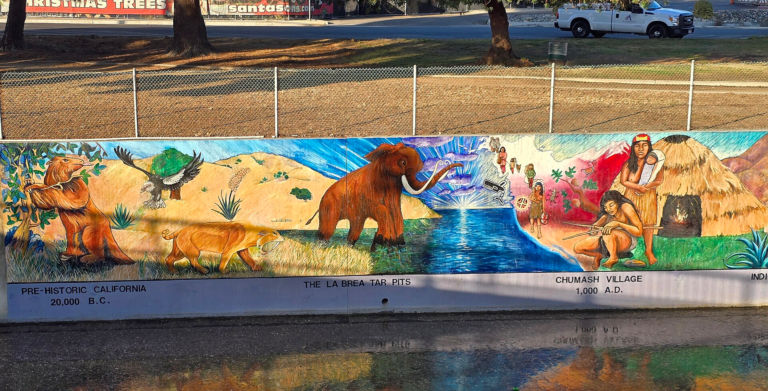
The Great Wall of Los Angeles is technically a flood-control channel. The Army Corps of Engineers built Tujunga Wash in the San Fernando Valley to move water fast and away — concrete walls, utilitarian geometry, nothing to linger on. In 1974, the Corps contacted Judith Baca about a beautification project. What followed was not beautification. It was something closer to an act of collective archaeology.
Baca spent the summer of 1977 in Cuernavaca studying mural technique at the Taller Siqueiros, absorbing the polyangular theory of David Alfaro Siqueiros — the idea that murals, unlike easel paintings, must account for a viewer in motion. She returned with a plan for an epic-scale history of California painted directly onto the wash's concrete walls, running more than half a mile in total. She called the process "Imagining of Content": research, expert consultation, interviews with survivors of historical events, collective decision-making, then drawings, critiques, color, and finally the wall itself. Each section took roughly a year from start to finish.
Over six summers beginning in 1978, more than 400 young people — many recruited from the juvenile justice system, many from neighborhoods that were, in Baca's word, "warring" — painted scenes spanning California prehistory to the 1950s. The Chumash creation story. Chinese railroad labor. Japanese-American internment. The Zoot Suit Riots. The disappearance of Rosie the Riveter. Gay rights activism. Biddy Mason. The birth of rock and roll. A flood in the final stretch washed away scaffolding and materials; the surrounding community raised $20,000 in two weeks to finish it.
The mural landed on the National Register of Historic Places in 2017. At 2,754 feet long and 13 feet high, it is one of the longest murals in the world — a chronicle that fills the kind of negative space official history tends to leave behind.
What to Spot
Scattered across the mural's panels, the names of the young people who painted it are recorded directly on the wall — small signatures and inscriptions worked into the imagery itself, preserving the individual hands behind the collective work.
Bonus Finds
- The very first panel, designed by Christina Schlesinger, depicts native wildlife and the Chumash creation story — a visual key to the mural's chronological logic before the 20th-century panels take over.
- The Japanese-American internment panel is one of the most concentrated sections of the mural, depicting the forced removal of 1942 in detail that neither softens the event nor editorializes around it — Social Realism used without sentimentality.
- A panel near the mid-section shows the Zoot Suit Riots of 1943 alongside the simultaneous erasure of Rosie the Riveter after the war — two moments of civil tension painted into direct visual proximity, a compositional argument rather than a caption.
Share your finds and tag us — @scavtopia.
Plan your visit
Scavtopia turns this place — and any place — into an adventure. Join the waitlist.
Photo: RobotGoggles / CC 4.0 / Pexels license