
Grand Central Market
Los Angeles
Story
Grand Central Market has never closed. Not for a recession, not for a pandemic, not for a century of Los Angeles remaking itself around it — the market opened in October 1917 and has run every day since, outlasting the department store it replaced, the railway that once fed it customers from Bunker Hill, and several complete reinventions of downtown itself.
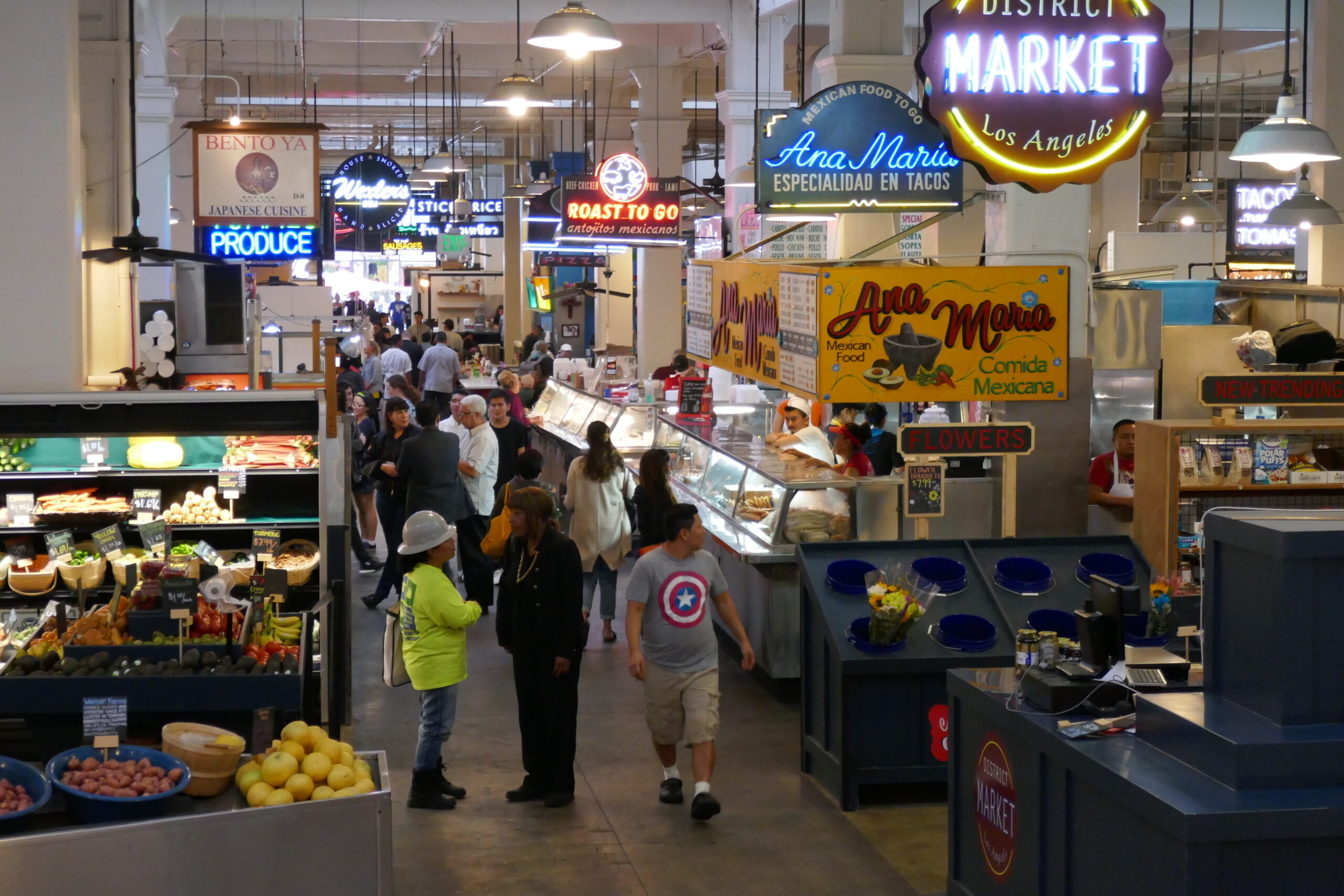
The building it occupies — the Homer Laughlin Building, completed in 1897 — was already twenty years old when the market moved in. Promoters called it "the largest and finest public market on the Pacific Coast," and by 1926 its 120 stalls were pulling forty thousand customers a day. Those customers arrived largely via Angels Flight, the funicular that climbed Bunker Hill just across Hill Street, and the market catered to them accordingly: oysters, specialty goods, lunch counters, florists. When Beverly Hills attorney Ira Yellin bought the market in 1985, the demographic math had long since shifted — the L.A. Times had estimated in 1978 that roughly half of the 180,000 weekly shoppers were Latino, and by 1985 food stamp purchases accounted for around 20 percent of sales. Yellin's instinct was not to move upmarket but to restore: stripping away a tile façade that had buried the second-story windows, recovering the Beaux Arts detailing underneath, and installing neon that reads as vintage because much of it is.
After the Great Recession vacancy hit 45 percent. It was Yellin's widow, Adele, who steadied it — threading legacy vendors alongside newer stalls like Wexler's Deli and EggSlut, and keeping the place from tipping into theme park or ghost town. The market sold again in 2017 to Langdon Street Capital, but the noise and density and overlap of it all — century-old institutional logic rubbing against a breakfast burrito queue — remains intact. Some markets are preserved. This one simply never stopped.
What to Spot
The original neon signage running along the Broadway and Hill Street entrances — hand-bent tubing in overlapping reds and yellows, some of it dating to Ira Yellin's 1980s restoration and some older, all of it still lit against the market's open ceiling during operating hours.
Bonus Finds
- The Hill Street facade preserves the Homer Laughlin Building's Beaux Arts upper stories, including the arched windows that Yellin's restoration uncovered after decades under a mid-century tile skin — visible from the sidewalk before you step inside.
- Several of the legacy vendor stalls have operated continuously for decades, their hand-painted signage and narrow footprints unchanged while the food-concept stalls around them turn over — a visible stratigraphy of the market's different economic eras.
- The Broadway entrance opens directly across from Angels Flight Railway, the 298-foot funicular that once delivered the market's original Bunker Hill clientele — the geometry of that relationship is still legible from the threshold.
Share your finds and tag us — @scavtopia.
Sightings
- Busting (1974) — a lengthy chase and shootout sequence runs through the market's stalls
- Midnight Run (1988) — bail bondsman Eddie Moscone (Joe Pantoliano) recruits bounty hunter Jack Walsh (Robert De Niro) over breakfast here at the film's outset
- Most Wanted (1997) — Gy. Sgt. James Dunn (Keenen Ivory Wayans) takes refuge in the market at the end of the thriller
- City of Angels (1998) — Seth (Nicolas Cage) and Dr. Maggie Rice (Meg Ryan) shop for produce together in the market
Plan your visit
Scavtopia turns this place — and any place — into an adventure. Join the waitlist.
Photo: NewtonCourt / CC BY-SA 4.0