
Flatiron Building
New York City
Story
The Flatiron Building shouldn't work. A 22-story tower on a triangular plot barely 6 feet wide at its northern tip — critics in 1902 called it "Burnham's Folly" and predicted the wind funneling between Fifth Avenue and Broadway would topple it. Daniel Burnham and structural engineers Purdy and Henderson disagreed, designing a steel frame calculated to withstand four times the maximum wind load the site was expected to generate. The building opened October 1, 1902, and it has not moved since.
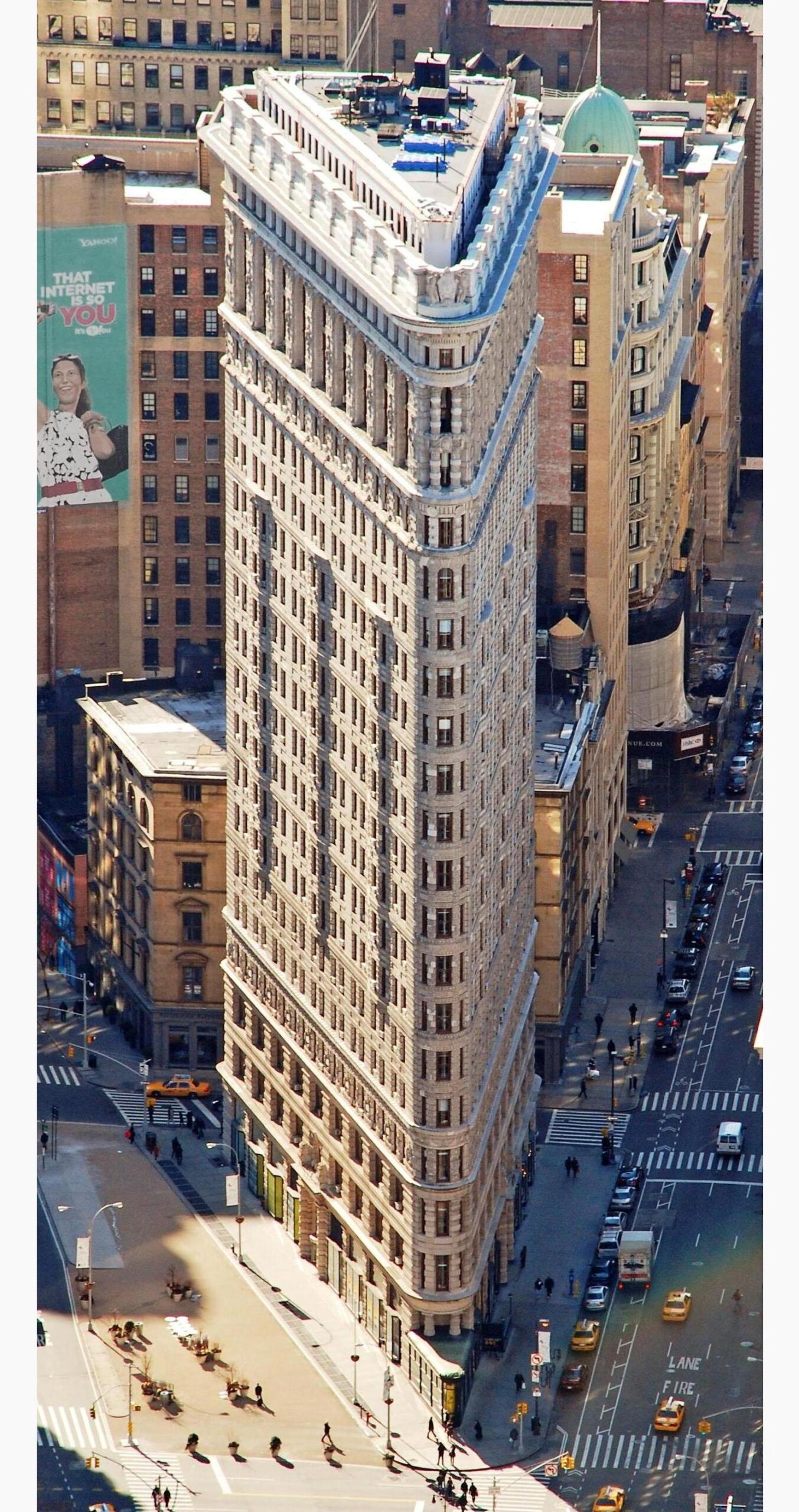
What almost no one registers, standing at the prow and staring up, is that the facade is doing something a flat wall never could. Burnham divided the exterior vertically into three bands — base, shaft, and capital — mirroring the proportions of a classical column. The lowest three stories are clad in limestone; everything above shifts to glazed terracotta, fabricated by the Atlantic Terra Cotta Company starting in August 1901 and pressed into an elaborate skin of Renaissance and Flemish ornament. At the northern peak, those two facades converge at a rounded corner barely wide enough to hold a window. The ornamentation doesn't stop or simplify there. It wraps the curve at full intensity, as if Burnham refused to let the geometry win.
The building's original name was the Fuller Building — home to the Fuller Company, the era's leading general contractor, whose CEO Harry S. Black had paid around $2 million for the site in May 1901. The "Flatiron" nickname came from the public, borrowed from the triangular cast-iron clothes irons of the day, and it stuck so completely that by mid-century even the surrounding neighborhood had taken the name. A folly that renamed a neighborhood: not a bad legacy for a building everyone expected to fall down.
What to Spot
At the building's narrow northern apex, where the Fifth Avenue and Broadway facades meet, the glazed terracotta ornamental cladding — foliate panels, Renaissance pilasters, and cartouche details — continues uninterrupted around the rounded corner, maintaining full decorative density all the way to a point that, at street level, is barely wider than a doorframe.
Bonus Finds
- The 22nd Street facade — the building's widest side at 86 feet — reads almost as a conventional office block from the south, offering little hint of the dramatic convergence happening at the opposite end. The contrast between this flat rear wall and the razor-edged prow to the north is most apparent from a few blocks down Broadway.
- A small attached retail structure originally hugged the building's base along 23rd Street, added shortly after the 1902 opening. Called the 'cowcatcher' by contemporaries — after the wedge-shaped guards on locomotive fronts — it echoed the prow shape of the building itself. The addition is gone, but the name survives in accounts of the building's early years.
- Before the Flatiron went up, the lot's previous owner Amos Eno rented the exposed northern wall of an earlier building on the site to advertisers — including a New York Times electric-light sign, reportedly the first of its kind in the city, and later a canvas screen used to project election results to crowds gathered in Madison Square. The future folly was already a landmark before it existed.
- The building's steel frame rose above street level by January 1902 but construction paused twice — once for delayed steel shipments from the American Bridge Company in Pennsylvania, and once for a labor strike — before the building opened that October. The frame completed in under a year is visible in its proportions: the floors taper with the triangle all the way up, so no two floor plates are exactly the same shape.
Share your finds and tag us — @scavtopia.
Sightings
- Spider-Man (2002) — the Flatiron Building appears prominently in establishing shots of Manhattan, helping anchor the film's version of New York
- Limitless (2011) — the building appears in street-level New York sequences used to establish the protagonist's downtown world
Plan your visit
Scavtopia turns this place — and any place — into an adventure. Join the waitlist.
Photo: Imelenchon/ Public domain