
Chrysler Building
New York
Story
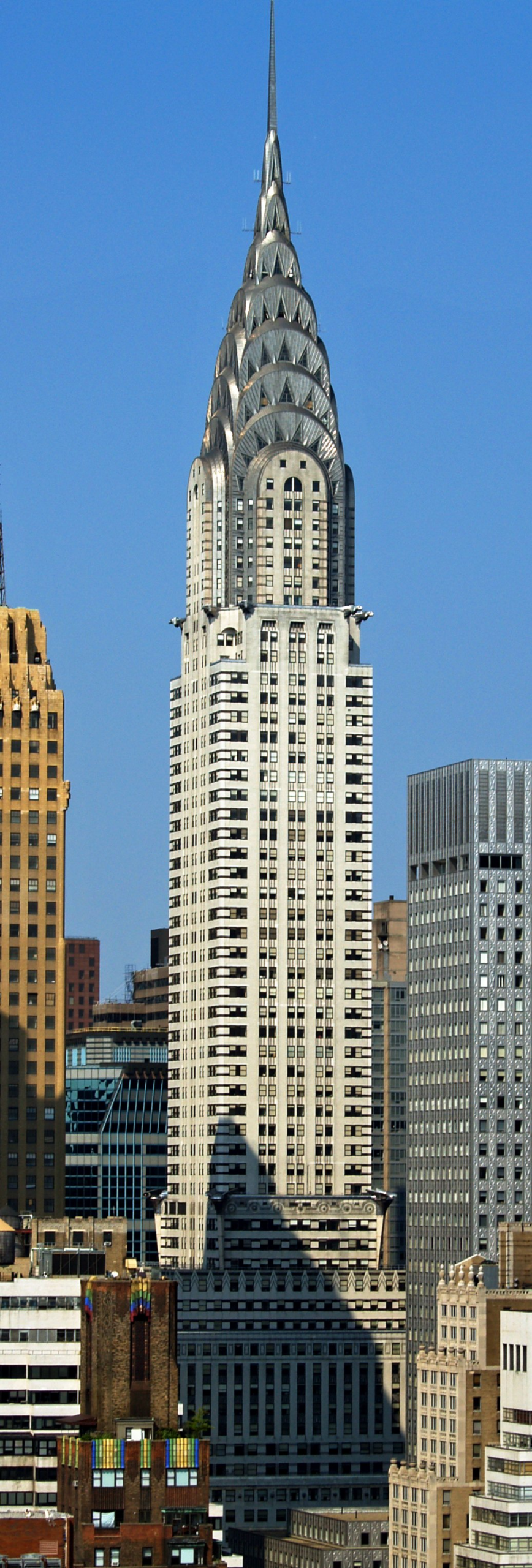
Everyone knows the crown. The terraced arches, the radiating stainless steel fins dissolving upward into a needle — that silhouette has been shorthand for New York ambition since 1930. What fewer people register is how quietly strange the building is at eye level, and how much of its most obsessive detail sits where no tourist thinks to look.
Walter Chrysler didn't commission the building through his corporation. He funded it personally, as a real estate investment for his children, and he hired architect William Van Alen with clear instructions: make it the tallest thing on earth. Van Alen obliged by secretly assembling a 185-foot steel spire inside the building's crown, then hoisting it through the roof in 90 minutes on October 16, 1929 — just in time to beat 40 Wall Street, which had been racing for the same title. The gambit worked. For 11 months, the Chrysler Building stood as the tallest structure ever built.
The material holding that crown together is equally strange. Van Alen clad the entire upper section in Nirosta stainless steel — an austenitic alloy developed by Krupp in Germany, composed of 18% chromium and 8% nickel. It was the first use of this alloy in an American building project. The American Society for Testing Materials was so uncertain how the material would weather that they formed an inspection committee in 1929 and examined the panels every five years until 1960, when they finally stopped because the steel had shown almost no deterioration.
The crown gets the glory. But at the 31st floor, Van Alen embedded something more unsettling: full-scale replicas of the 1929 Chrysler automobile radiator cap, jutting from the corners like chrome gargoyles over a medieval cathedral. The building is, at its core, a monument to a car company — and at the 31st floor, it admits that plainly.
What to Spot
The corner ornaments at the 61st floor — large silver eagle heads with outstretched wings, each one projecting from the building's corners at a steep downward angle against the steel-clad crown above.
Bonus Finds
- At the 31st floor, the building's four corners carry oversized replicas of the 1929 Chrysler radiator cap — the same winged ornament found on the hood of the automobile — rendered in Nirosta stainless steel at a scale that reads as architectural rather than decorative.
- The Lexington Avenue entrance lobby is triangular in plan, paneled in African marble with veining that shifts across every surface, and topped by a ceiling mural painted by Edward Trumbull in 1930 depicting transportation, human industry, and — prominently — the Chrysler Building itself under construction.
- The ground-floor exterior sits on polished black Shastone granite, with the three floors above it clad in white Georgia marble — a quiet material contrast that most visitors walk straight past without registering the shift.
- The building occupies a subtly trapezoidal footprint because its eastern edge follows the old Boston Post Road, which predates the Manhattan grid established by the Commissioners' Plan of 1811 and cuts across it at an angle.
Share your finds and tag us — @scavtopia.
Sightings
- Armageddon (1998) — the building appears in destruction sequences as debris strikes Manhattan
- Spider-Man (2002) — visible in skyline shots establishing the film's New York setting
Plan your visit
Scavtopia turns this place — and any place — into an adventure. Join the waitlist.
Photo: w:User:Overandderivative work: Overand (talk) / Public domain