
Barringer Meteor Crater
Winslow, Arizona
Story
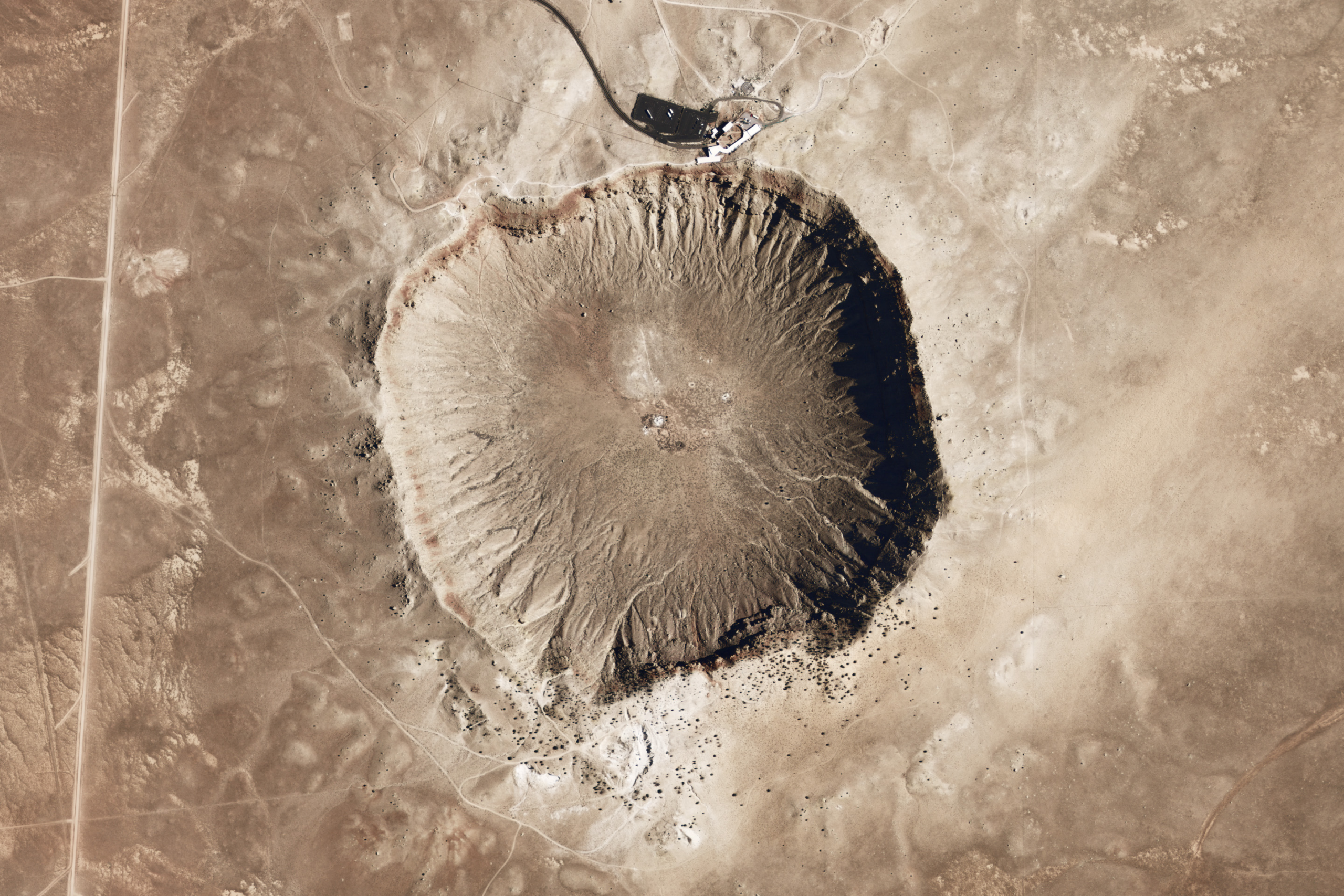
Everyone comes for the scale. The crater is nearly a mile across and 560 feet deep, and the numbers are so large they almost stop meaning anything until you're standing at the rim and the far wall is still a quarter mile away. That's the expected revelation. The unexpected one belongs to Daniel Moreau Barringer, a Philadelphia mining engineer who staked a claim here in 1903 convinced that a massive iron meteorite — worth a fortune in nickel and steel — lay buried just beneath the crater floor. He spent the next 26 years and his personal fortune drilling for it. He died in 1929 without finding a gram. The meteorite hadn't buried itself. It had largely vaporized on impact, the kinetic energy of a 150-foot-wide iron mass traveling at roughly 26,000 miles per hour converting almost entirely into heat and shock in a fraction of a second. Barringer had been looking for something that no longer existed in any recoverable form.
The crater his obsession preserved is now the best-studied impact site on Earth. In the early 1960s, geologist Eugene Shoemaker used it to train Apollo astronauts — the closest analog to lunar terrain available on American soil. Shoemaker also used Barringer to establish that the crater was impact-formed at all, something genuinely contested by scientists into the mid-20th century. The proof was coesite and stishovite, rare high-pressure forms of silica that only form under the extreme shock of a hypervelocity impact. He found them in the crater walls. The science of impact cratering, the field that now underpins our understanding of planetary formation, effectively grew up here.
What to Spot
The exposed crater walls show rock strata that have been tilted upward and in places completely overturned — layers of Coconino sandstone, Kaibab limestone, and Moenkopi formation folded back on themselves by the blast, with older rock sitting visibly above younger rock in a sequence that runs opposite to how geology normally stacks.
Bonus Finds
- A specimen of Canyon Diablo meteorite — the official name for fragments of the impactor — is on display at the visitor center, a dense, pocked chunk of nickel-iron that survived only because it was thrown clear of the impact zone rather than caught in it.
- A full-scale model of an Apollo-era astronaut in a spacesuit stands at the rim overlook, marking the site's role as a lunar training ground — an oddly quiet monument to a connection between this desert hole and the Moon.
- The drilling rig equipment associated with Barringer's mining operations is referenced in the on-site exhibits; the crater floor where he drilled for decades is visible directly below the main rim viewpoint, flat and unreachable.
Share your finds and tag us — @scavtopia.
Plan your visit
Scavtopia turns this place — and any place — into an adventure. Join the waitlist.
Photo: National Map Seamless Server / Public domain