
Bannerman Castle
Pollepel Island, New York
Story
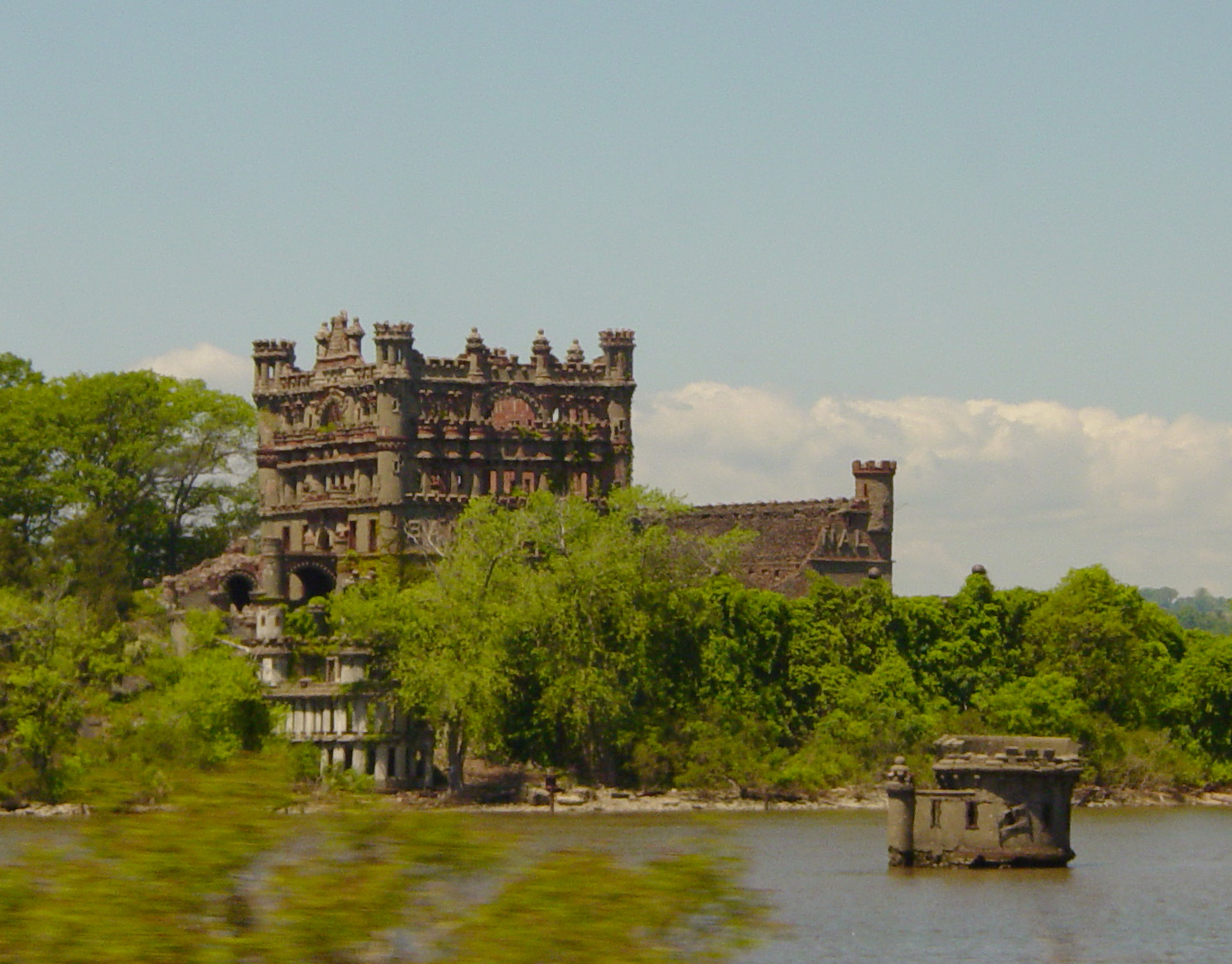
Francis Bannerman VI did not set out to build a ruin. In 1900, he purchased Pollepel Island — a 6.5-acre outcrop rising from the Hudson River roughly 50 miles north of Manhattan — and began constructing a warehouse to hold the staggering quantity of military surplus he'd accumulated after buying up U.S. Army stockpiles following the Spanish-American War of 1898. He needed somewhere to put the rifles, artillery shells, uniforms, and ammunition that his Brooklyn store could no longer absorb. What he built instead was a Scottish baronial castle, complete with turrets, crenellations, and towers that mirror the cliffs and storm-light of the Hudson Valley as though they'd always been there.
Bannerman designed much of it himself, with an enthusiasm that outpaced any formal architectural training. Construction ran from 1901 until his death in 1918, with the island serving as both arsenal and advertisement — a monument to his business visible to every passenger on the Hudson River Line. The lettering he had cut into the facade made certain no one missed the point.
Then the island began to reclaim it. In 1920, roughly 200 pounds of shells and powder detonated inside the walls, blowing out a section of the arsenal and scattering debris across the river. New York State acquired the island in 1967. A fire gutted the interior in 1969. Decades of winters finished what the explosion started. The towers still stand, but hollowed — walls open to the sky, floors collapsed, the whole structure caught in a long, slow exhale that has lasted over a century. What Bannerman built as a monument to commerce has become something stranger and more lasting: a genuine ruin, at an age when genuine ruins are hard to come by.
What to Spot
The large block letters spelling "BANNERMAN'S ISLAND ARSENAL" cut directly into the river-facing facade of the main warehouse building, still legible from the water despite more than a century of exposure and partial structural collapse around them.
Bonus Finds
- The rounded corner tower at the arsenal's waterfront edge, its upper stonework open to the sky and the interior floors entirely gone — the tower reads as complete from a distance and hollow up close.
- A separate, smaller structure set apart from the main arsenal: the powder magazine, built deliberately isolated from the rest of the complex after Bannerman recognized the explosive risk of storing live ordnance alongside everything else.
- The Bannerman family residence on the island's southern end — a separate building from the arsenal, more domestic in scale, with decorative stonework details that show a different register of ambition than the warehouse towers.
Share your finds and tag us — @scavtopia.
Plan your visit
Scavtopia turns this place — and any place — into an adventure. Join the waitlist.
Photo: User:Leonard G. / Public domain