
Angels Flight
Los Angeles
Story
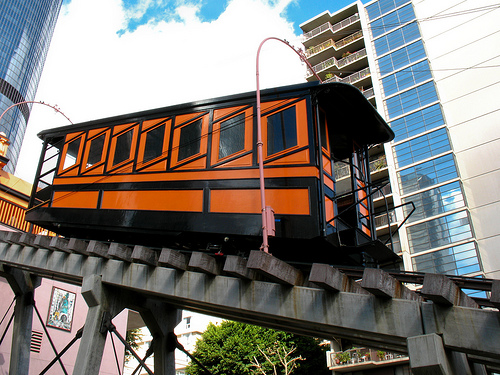
The shortest incorporated railway in the world almost never came back. When the city of Los Angeles shut down Angels Flight on May 18, 1969 — clearing Bunker Hill for the gleaming corporate district that replaced a neighborhood of 22,000 working-class residents — the two vermillion funicular cars, Sinai and Olivet, were hauled to a warehouse at 1200 S. Olive Street and left there. They sat for 27 years. Sid and Linda Kastner stored them at no charge inside their United Business Interiors building, where one car became part of a private museum and the other gathered dust in a garage, both waiting on a city promise that kept getting deferred.
The railway Colonel J. W. Eddy built in 1901 had covered just 315 feet of Hill Street at a 33 percent grade — a bright orange bracket connecting downtown Los Angeles to the hilltop neighborhood above it. By its fiftieth year, it had carried more than a hundred million passengers. Then redevelopment swallowed the block and the cars disappeared into storage.
When the Angels Flight Railway Foundation finally reopened the line on February 24, 1996, it rebuilt the track half a block south of the original site, with a new haulage system designed for the new geometry. That redesign failed catastrophically on February 1, 2001, when car Sinai rolled uncontrolled downhill and struck Olivet near the lower station, killing an 83-year-old man. Another decade of investigation, repair, and safety overhaul followed before the cars ran again in August 2017.
The names on those cars — Sinai and Olivet, two biblical peaks — have been climbing and descending this hill, in one form or another, for over a century. Whatever the city did to the neighborhood around them, the cars themselves survived.
What to Spot
The ornamental arch spanning the Hill Street entrance carries the name "ANGELS FLIGHT" in raised lettering — the same arch that greeted passengers at the original 1901 station and was recovered from outdoor storage in Gardena before the 1996 reconstruction.
Bonus Finds
- A plaque mounted at the lower station, erected in November 1952 by the Beverly Hills Parlor of the Native Daughters of the Golden West, describes Angels Flight as "a friend of President Abraham Lincoln's" project and records the hundred-million-passenger milestone — a dense little time capsule bolted to the wall of a railway that had already been closed, demolished, and rebuilt twice since the plaque went up.
- The two cars, Sinai and Olivet, are not merely named after biblical mountains — they run in opposite directions on a single shared cable, so whenever one ascends, the other descends. Watching them pass midway up the track is the clearest illustration of how a counterbalanced funicular actually works.
- The upper station opens onto California Plaza, a broad terrace that gives a clean sightline down into the Historic Core below — the same view that once looked over Victorian rooftops before redevelopment cleared them in 1969.
- The current track sits half a block south of where the original line ran. The original Angels Flight connected Hill Street to Olive Street; the rebuilt version connects Hill Street to California Plaza. The shift is small on a map but means the cars have never technically returned to their original route.
Share your finds and tag us — @scavtopia.
Sightings
- 500 Days of Summer (2009) — the funicular appears as part of a downtown Los Angeles montage, the Hill Street entrance briefly visible
Plan your visit
Scavtopia turns this place — and any place — into an adventure. Join the waitlist.
Photo: Alossix / CC BY 3.0