
Adamson House
Los Angeles
Story
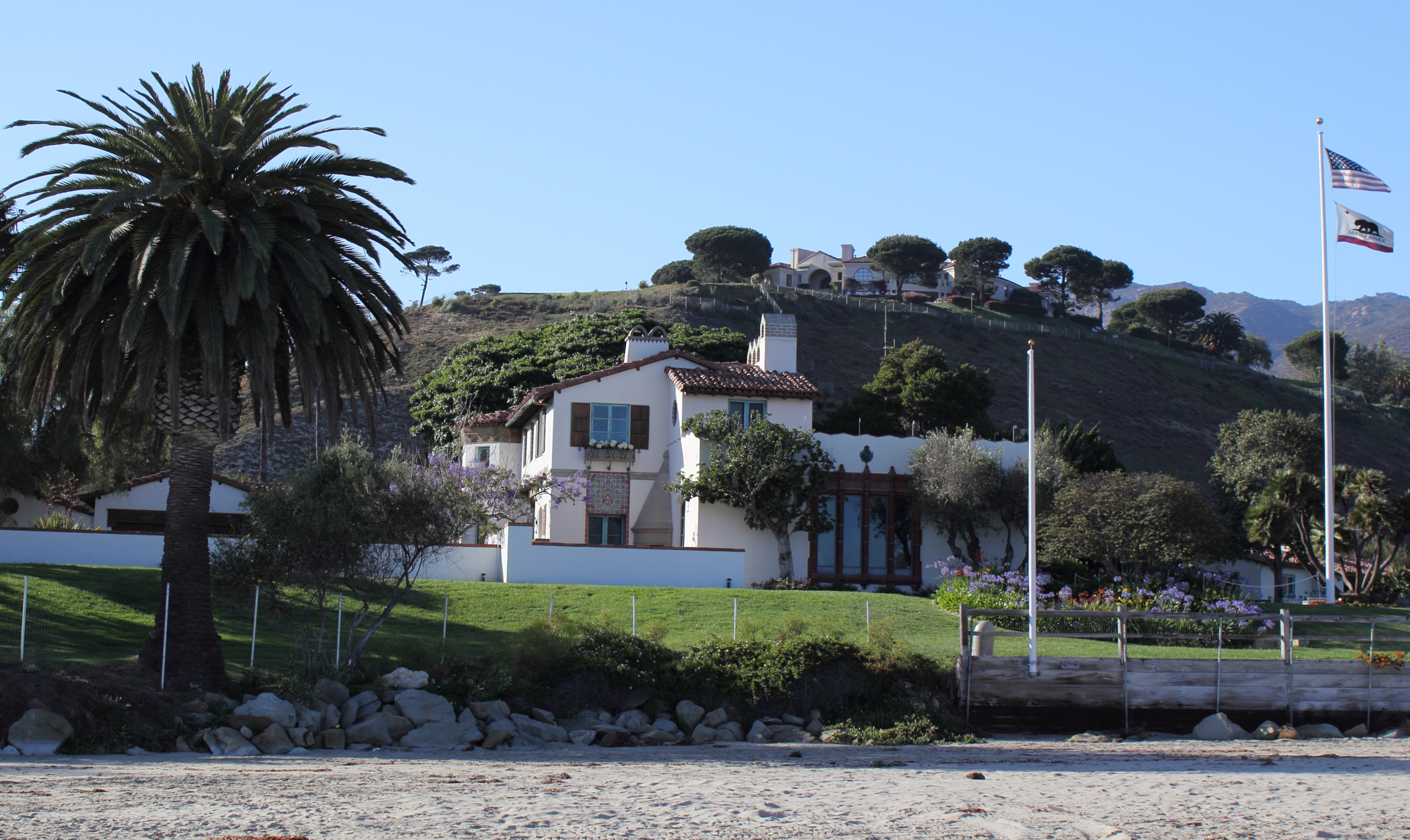
The Adamson House sits at the edge of Malibu Lagoon, close enough to the Pacific that salt air has been working on its walls since 1930 — and most people who pass it on PCH have no idea it exists. What they're missing is one of the most extravagant uses of decorative ceramic tile in the United States, built into a private beach house as casually as wallpaper.
The story starts with a dynasty. Frederick Hastings Rindge, a Boston businessman, acquired the Rancho Topanga Malibu Sequit land grant in the 1890s and eventually controlled most of what is now Malibu. His widow, May K. Rindge, fought for decades to keep the state from running a highway through her land — and lost. Their daughter, Rhoda Rindge Adamson, and her husband Merritt built this house in 1929 on a design by Stiles O. Clements of the firm Morgan, Walls & Clements. Clements called it a modified Mediterranean Revival. Architectural historians call it a synthesis of Spanish Colonial and Moorish Revival. Either way, it is spectacularly itself.
The tile is the thing. In 1926, May Rindge established a tileworks east of the Malibu Pier and put ceramic engineer Rufus Keeler in charge. Keeler's operation employed more than 100 people at its peak, producing hand-crafted glazed tile fired from local clay that became some of the most inventive decorative ceramics of the era. Every room in the Adamson House received its own custom designs. The factory operated for just six years, closing in 1932, which makes this house one of the most complete surviving records of what Malibu Potteries produced.
The state of California tried to raze it in 1966 to build beach parking. That plan, fortunately, failed. California Historical Landmark No. 966 was designated in 1977, and the National Register of Historic Places added it in 1985. The Adamsons' furniture, Rhoda's hat collection, and the radio on which the family heard news of Pearl Harbor are still inside.
What to Spot
A 60-foot tile carpet laid into the exterior grounds, its surface composed of small geometric pieces including border sections shaped and glazed to imitate the knotted fringe of a woven Persian rug.
Bonus Finds
- The Neptune Fountain, Peacock Fountain, and Star Fountain are set into the exterior of the house — each one a different demonstration of what Rufus Keeler's tileworks could do, ranging from dense geometric patterning to pictorial majolica-style color.
- Outside one of the upstairs bedrooms, a large Dombeya tree blooms in spring with clusters of bright red flowers — an almost theatrical contrast against the white stucco walls of the house.
- An elaborately tiled outdoor tub survives on the grounds, built specifically so the Adamsons could bathe their dogs — the same level of tilework craft applied to something entirely mundane.
- The son's bathroom upstairs is covered in tiles depicting ships and nautical scenes, each panel a hand-designed composition rather than a repeated pattern — a reminder that Keeler's team treated every surface as a separate commission.
Share your finds and tag us — @scavtopia.
Plan your visit
Scavtopia turns this place — and any place — into an adventure. Join the waitlist.
Photo: Սէրուժ (Serouj Ourishian) / CC BY-SA 3.0