
The Original Farmers Market at Fairfax and Third doesn’t announce itself as something to solve. At first glance, it looks like what it is most often described as: a place to eat. A collection of food stalls. A convenient stop between museums, shopping, or a day spent crossing Los Angeles off a list.
But if you slow down, it reveals itself differently.
The market began in 1934 as a loose gathering of farmers selling produce from the backs of their trucks. That informal beginning still shapes the way the place feels today. Instead of a single design language, the market is made up of layers—signs added decades apart, stalls expanded and repainted, logos refreshed or left untouched. Nothing was wiped clean and redone all at once. The result is a space that rewards attention.
Walk it like a scavenger hunt and the clues start to appear.
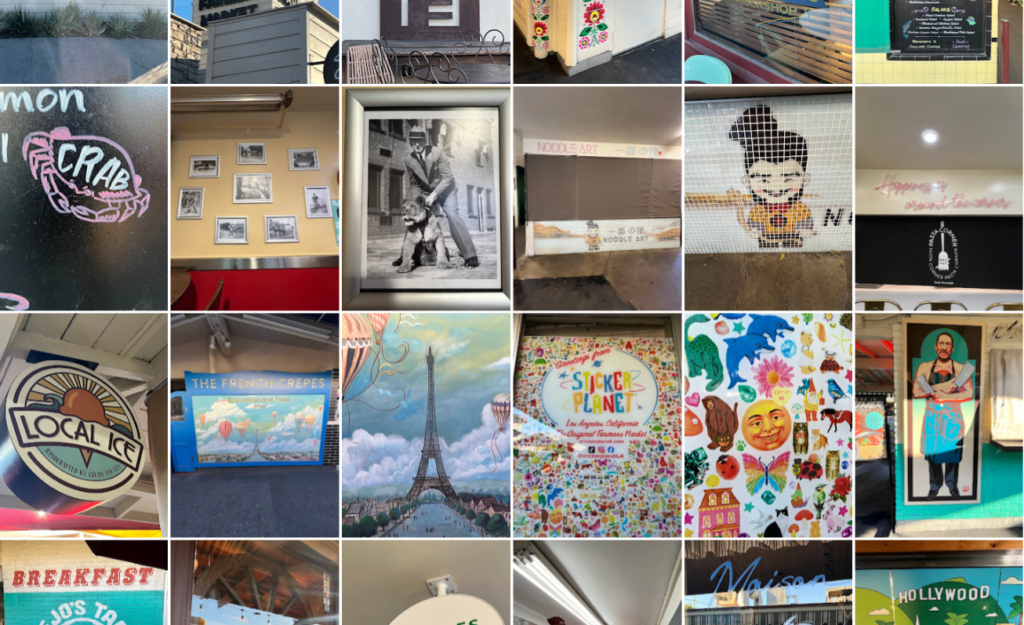
Look for the old lettering that hasn’t been updated because it didn’t need to be. The chalkboards that change daily, sitting beside permanent signs that haven’t changed in years. Hand-painted illustrations, mosaic tiles, cartoon mascots, and window graphics that tell you what kind of place you’re about to step into before you ever read the menu.
Some details are loud and colorful. See if you can find a section of a wall covered in stickers, a mural of old Paris packed with color, a playful character tiled into a storefront, Ama & Togo–the Farmer’s Market robots.
Too easy? Keep going.
Find a framed photograph of a man with a leashed lion tucked inside a counter-service stall, a banana peel in pink hightops doing a jumping split, a colorful chalk-on-blackboard southern menu, another menu in the shape of a giant fish…
For travelers, this is one of the easiest places in Los Angeles to practice noticing. You don’t need context or local knowledge. You don’t need to know which vendor is famous or what’s been here the longest. The market is compact, walkable, and dense with visual information. Every few steps, there’s something new to register.
The hunt doesn’t have a finish line. You can make one for yourself. Count the different styles of lettering you pass. Look for repeated symbols—animals, flags, smiling faces. Notice how many ways food is advertised before you ever smell it. Pay attention to what feels preserved versus what feels improvised.
Just outside, the city shifts tone. Polished retail and carefully staged experiences take over. Inside the market, things stay human-scaled. Slightly uneven. Clearly used. That contrast is part of what makes this corner of Los Angeles feel real.
If you’re only here to eat, you’ll eat well. If you’re willing to wander, you’ll find something more interesting.
This is the kind of place that turns looking into a game. And that’s exactly the kind of exploration Scavtopia is built for—here and anywhere. There’s a waitlist if you’re curious.