
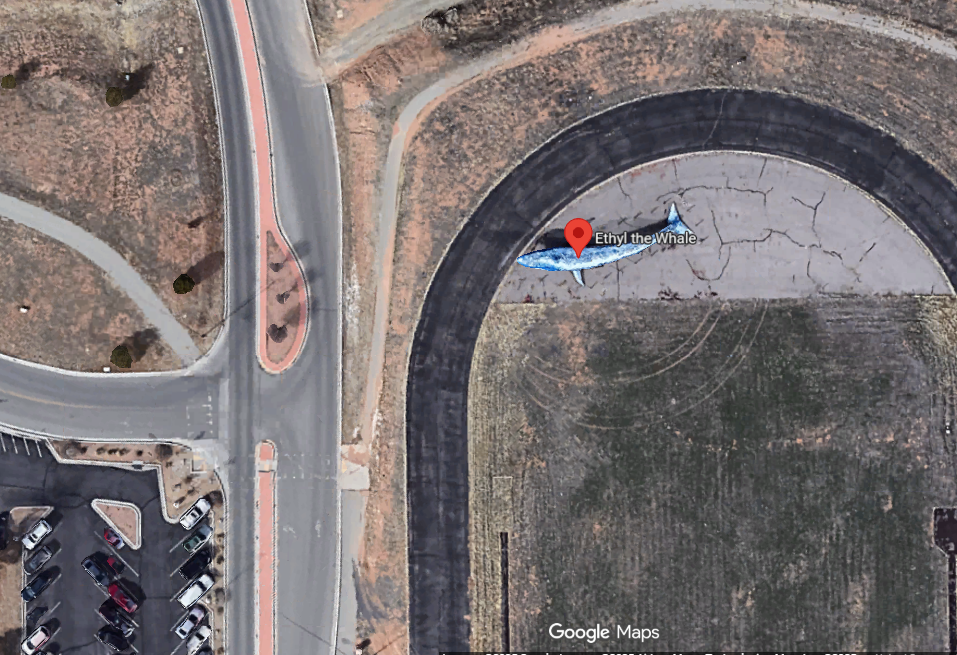
There’s a full-sized blue whale in the middle of Santa Fe’s high desert.
Not metaphorically. Not in a museum. An actual 82-foot-long blue whale sculpture sitting on a field behind Santa Fe Community College, glowing from within when the sun goes down.
Her name is Ethyl—short for polyethylene, the plastic she’s made from. And she’s here to tell you something.
The Whale Made of What We Throw Away
Artists Joel Stockdill and Yustina Salnikova built Ethyl in San Francisco over six months with a crew of 50+ artists and volunteers. The sculpture is made entirely of hand-recycled plastic—mostly type #2 plastic from laundry detergent bottles and milk jugs. Over 4,000 pounds of donated plastic went into her construction.
The concept came from a devastating statistic: every nine minutes, the weight of a blue whale in plastic enters the ocean. So they built an actual blue whale—life-sized, accurate, beautiful—out of the very thing killing her real-life counterparts.
She’s based on a whale that washed up on the beach in Bolinas, California. A portrait of an actual creature.
Originally commissioned by the Monterey Bay Aquarium, Ethyl was purchased by Santa Fe art collective Meow Wolf in 2019. They disassembled her and drove her 1,080 miles east to the high desert, where she landed on Earth Day 2019.
Ethyl holds the Guinness World Record for the world’s largest recycled plastic sculpture.
Why a Whale in the Desert Works
Santa Fe is about as far from the ocean as you can get. That’s exactly the point.
The weirdness stops you. You’re driving around a community college campus and suddenly—there’s a whale. Life-sized. In the desert. Made of trash.
It shouldn’t make sense. But it does.
Salnikova says they hope to spark inspiration for action and raise awareness for plastic pollution. The sculpture becomes a teaching tool—students at SFCC explore Ethyl through art, science, sustainability, and literature.
But mostly, she’s a presence. You can walk around her, see the plastic panels up close, watch how light filters through recycled detergent bottles. At night, she’s internally lit and glows against the desert sky.
The Perfect Find For
Families: Kids lose their minds over a whale in the desert. It’s surreal, it’s huge, and it sparks questions about where all that plastic goes.
Eco-conscious explorers: Art with a message that doesn’t preach—it just shows you the scale of the problem in physical form.
Anyone who loves weird roadside finds: This is Atlas Obscura-level stuff. A blue whale. In New Mexico. Built from milk jugs.
People seeking Santa Fe beyond the galleries: The art isn’t in a museum. It’s just sitting there on a college field, free to visit, impossible to miss.
How to Find Ethyl
Address: 86 College Dr, Santa Fe, NM 87508
Getting there: Drive south on Richards Avenue, go under US-85. At the second traffic circle, turn left onto College Drive, then right onto the SFCC campus. You’ll see the whale on the left at the end of the running track.
When to visit:
- During the day to see the details of the recycled plastic panels
- At night when she glows from solar-powered internal lights
- Free and accessible year-round
Good to know: You can walk right up to her. No gates, no admission fee. Just a whale waiting in the desert.
What Ethyl Says Without Words
Salnikova says, “We hope Ethyl has her own voice and can speak for herself.”
And she does. Not through signs or lectures, but through sheer presence. An 82-foot sculpture made from the plastic we use once and forget about. A blue whale that traveled from the California coast to the high desert to remind us that plastic doesn’t just disappear—it ends up somewhere.
In this case, it became art. In the ocean, it becomes something else entirely.
Ethyl isn’t just sculpture. She’s a message you can walk around, a conversation starter that works on kids and adults alike, and proof that sometimes the most powerful environmental statements don’t come from data—they come from standing next to something massive and beautiful and impossible, built from what we threw away.
The world is a game. You’re already playing.
Join the adventure early.
We’re mapping cities clue by clue.
Be among the first explorers when we launch.
Photo from Google Maps.