
Thor’s Well
Yachats, Oregon
Story
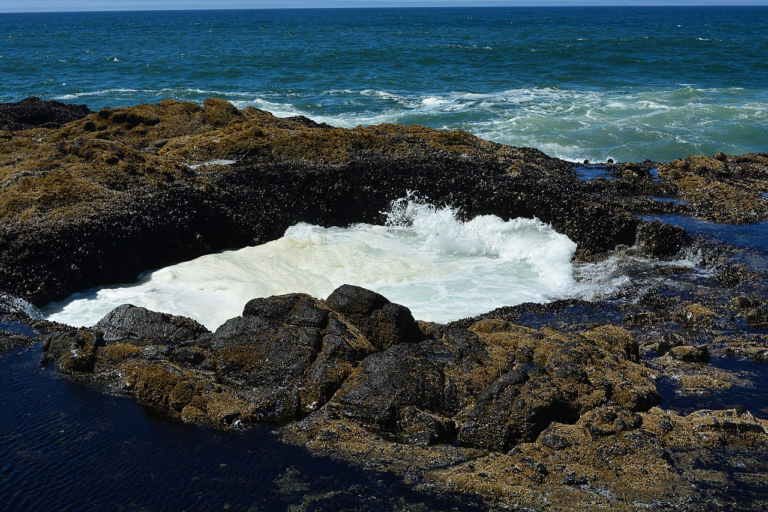
A ragged hole in the basalt shelf at Cape Perpetua, roughly 20 feet across, Thor's Well pulls incoming waves down into itself and spits them back skyward in a column of white water. The effect is so theatrical that it's easy to assume the geology is doing something impossible.
The well is a collapsed sea cave, most likely formed over thousands of years as Pacific swells undercut the basalt shelf until the roof gave way. At moderate tide, water rushes in through a submerged opening at the base, surges upward through the throat of the hole, and erupts. At high tide with a strong swell, the surrounding platform floods and the whole shelf becomes something closer to a cauldron — water sheets across the rock in every direction while the well keeps pulling and releasing at its own rhythm.
Cape Perpetua was named in 1778 by Captain James Cook, who spotted the headland on the feast day of St. Perpetua while charting the Pacific Northwest coast. The land is now managed by the Siuslaw National Forest, part of a stretch of Oregon coastline that has stayed almost entirely undeveloped. Thor's Well sits at the southern end of the Cape Perpetua Scenic Area, reachable via a short trail from the Spouting Horn parking area.
The well is most dramatic in the two hours around high tide, particularly in winter when the Pacific sends in long-period swells from distant storms. At slack low tide it reads as a fairly quiet hole in the rock — the machinery is there, but resting. The difference between the two states is so extreme it feels like visiting two separate places.
What to Spot
The submerged arch at the base of the well, visible during the brief pause between surges at moderate tide — a dark oval opening in the basalt where each wave enters before the column erupts upward.
Bonus Finds
- Spouting Horn, a narrow basalt crack roughly 50 yards north of Thor's Well, where waves compress into a pressurized jet and fire upward — a different mechanism from the well, and easy to miss if the well has your attention.
- The tidepools along the basalt shelf between the two formations hold sea stars, anemones, and purple urchins in shallow depressions — some pools are deep enough that the color shifts from green to near-black at the center.
- The Cape Perpetua Shelter, a stone-and-timber structure built by the Civilian Conservation Corps in 1933, sits on the headland above — a rare intact CCC building with a view that takes in the full arc of the coastline from the well to the tree line.
Share your finds and tag us — @scavtopia.
Plan your visit
Scavtopia turns this place — and any place — into an adventure. Join the waitlist.
Photo: Joe Mabel / CC BY-SA 4.0