
Biosphere 2
Oracle, Arizona
Story
Biosphere 2 was built to be a planet in miniature — 3.14 acres of sealed glass and steel in the Sonoran Desert, engineered to keep eight people alive without a single breath from the outside world. The name was deliberate: Earth is Biosphere 1. This was the second.
Construction ran from 1987 to 1991, funded almost entirely by Texas billionaire Ed Bass, who committed $150 million to the project after meeting systems ecologist John P. Allen at the Synergia Ranch, a counterculture commune in New Mexico. The structure's glass-and-steel spaceframe was designed by Peter Jon Pearce, a one-time associate of Buckminster Fuller — and the engineering had to be extraordinary. Seals tight enough that oxygen loss during the first two-year mission still measured less than 0.25 percent per month.
On September 26, 1991, eight crew members sealed themselves inside: Roy Walford, Jane Poynter, Taber MacCallum, Mark Nelson, Sally Silverstone, Abigail Alling, Mark Van Thillo, and Linda Leigh. They grew most of their own food — bananas, sweet potatoes, rice, wheat, cowpea beans — and reported near-constant hunger in the first year. By the end, they had lost an average of 16 percent of their body weight. Oxygen quietly bled from the atmosphere. Nineteen species of vertebrates went extinct inside. Morning glories ran rampant.
But inside this slow-motion struggle, something worked. The agricultural system produced at yields estimated to exceed the most efficient farms in Southeast Asia. The crew's health markers — cholesterol, blood pressure, immune function — improved measurably. The experiment was not a failure. It was something stranger: a partial success in conditions no one had fully anticipated.
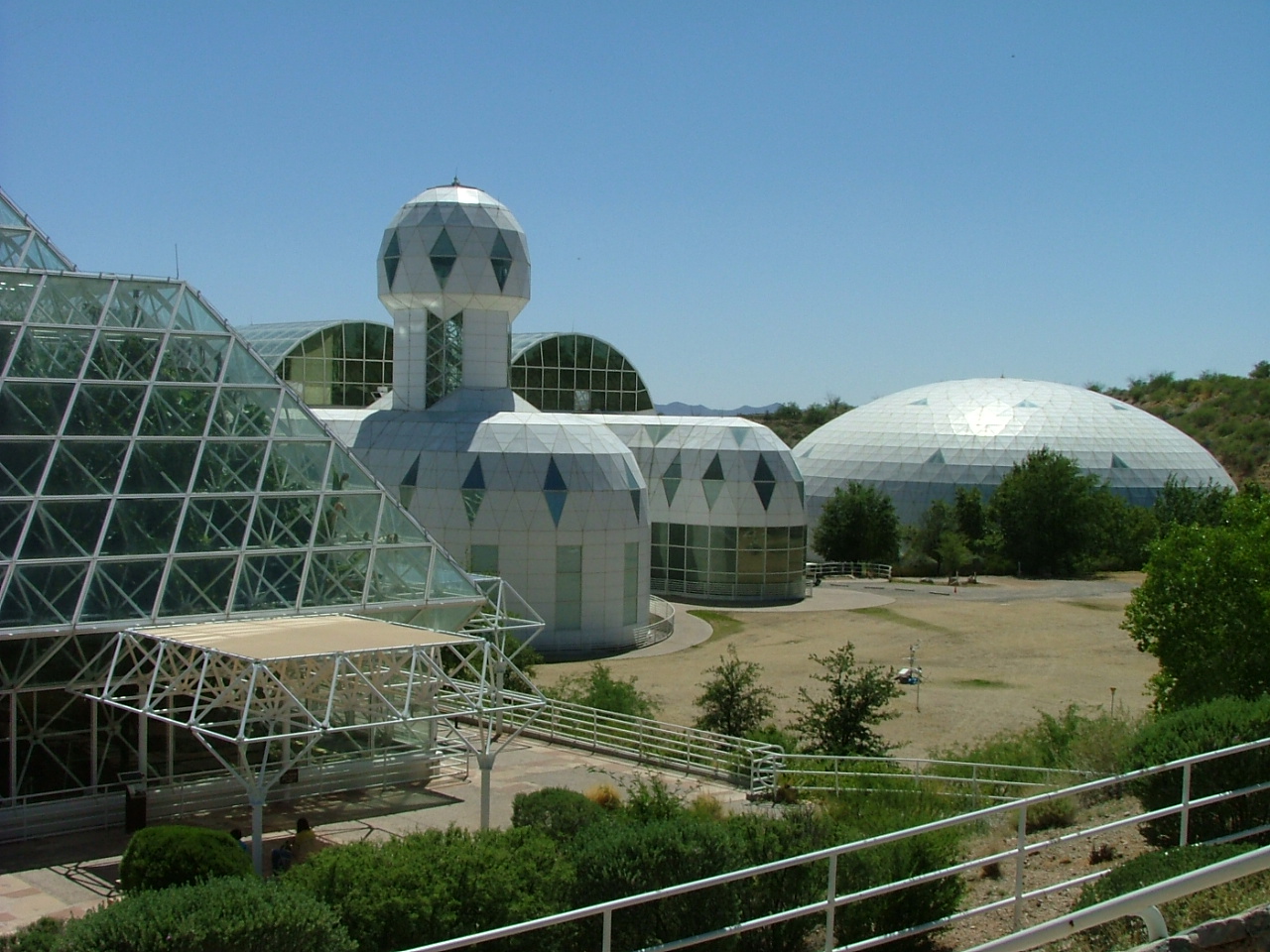
One engineering problem nobody could fully solve sits above everything, visible to anyone who looks up. The sun heats the air inside during the day; at night it cools and contracts. Rather than fight those forces — which would have been structurally ruinous — the designers built pressure-relief chambers called "lungs": enormous white domes where a giant flexible diaphragm rises and falls with the building's breath.
What to Spot
The two white domed "lung" structures on the exterior — each containing a massive flexible diaphragm that physically inflates and deflates to equalize air pressure inside the sealed structure as temperatures shift between day and night.
Bonus Finds
- The seven distinct biome zones visible through the glass from the exterior and interior tour — including the coral reef ocean tank and the rainforest volume, whose canopy reaches toward the spaceframe overhead.
- The agricultural bay, where the eight crew members grew the crops that supplied 83 percent of their diet during the 1991–1993 mission — the layout of grow beds and irrigation infrastructure is still visible on the tour.
- A plaque and crew documentation inside the facility identifying all eight Biosphere 2 Mission 1 crew members, including physician Roy Walford, whose calorie-restriction research directly shaped what the crew ate for two years.
Share your finds and tag us — @scavtopia.
Plan your visit
Scavtopia turns this place — and any place — into an adventure. Join the waitlist.
Photo: DrStarbuck at Flickr / CC BY 2.0