
The Awakening
National Harbor, Maryland
Story
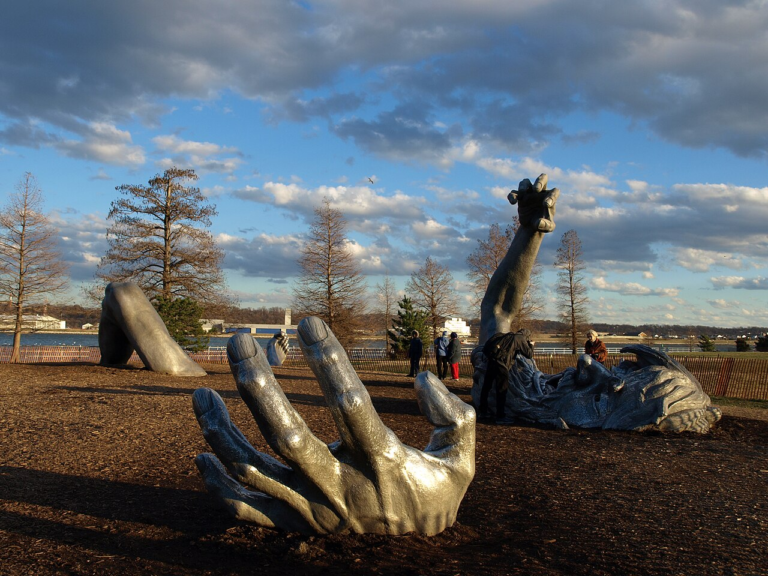
The sculpture doesn't read as five separate pieces until you're standing in the middle of them. J. Seward Johnson Jr. installed The Awakening at Hains Point in Washington, D.C. in 1980 — a giant aluminum figure erupting from the earth in five disconnected fragments: a contorted head, two straining hands, and two legs driving upward from the ground as if the entire lawn were a skin being shed. For nearly three decades it lived at the tip of East Potomac Park, where joggers and picnickers learned to treat a severed giant hand as ordinary scenery.
In 2008, Peterson Companies purchased the sculpture and relocated it to the newly developed waterfront at National Harbor, Maryland. The move was contentious — Washingtonians had claimed the piece, and its departure from Hains Point felt like a theft of something that had become public property through sheer repetition. But National Harbor gave the figure something Hains Point never quite did: open space and a waterfront horizon, so the emerging giant now appears to be clawing its way up from the edge of the Potomac.
The scale doesn't fully register in photographs. The head alone stands roughly 17 feet tall. Children regularly climb into the open mouth or brace themselves against the upthrust fist, which makes the geometry suddenly legible — human bodies becoming the unit of measure that snaps the giant into focus. Johnson made his career out of hyperrealist bronze figures that blend into everyday scenes, but The Awakening inverts that entirely. There is nothing subtle here. What the sculpture insists on is the terror and exhilaration of emergence — something enormous waking up beneath the ordinary world, and the ground not holding.
What to Spot
The open mouth of the giant's head, cast in aluminum with visible interior detail — teeth, a tongue, and the rough-textured throat receding into darkness inside the sculpture.
Bonus Finds
- The five separate pieces are spread across a surprisingly large footprint — standing beside the head, the nearest hand is far enough away that the full body outline only becomes clear from a distance or from an elevated vantage.
- The aluminum surface across the hands and forearms shows a striated, muscle-mapped texture that Johnson sculpted to read as both anatomy and anguish — most visible on the tendons of the outstretched fingers.
- A small interpretive marker near the sculpture identifies Johnson and the work's original 1980 installation date at Hains Point, D.C., quietly noting its displacement to National Harbor in 2008.
Share your finds and tag us — @scavtopia.
Plan your visit
Scavtopia turns this place — and any place — into an adventure. Join the waitlist.
Photo: William F. Yurasko / CC BY 2.0