
Ryman Auditorium
Nashville, Tennessee
Story
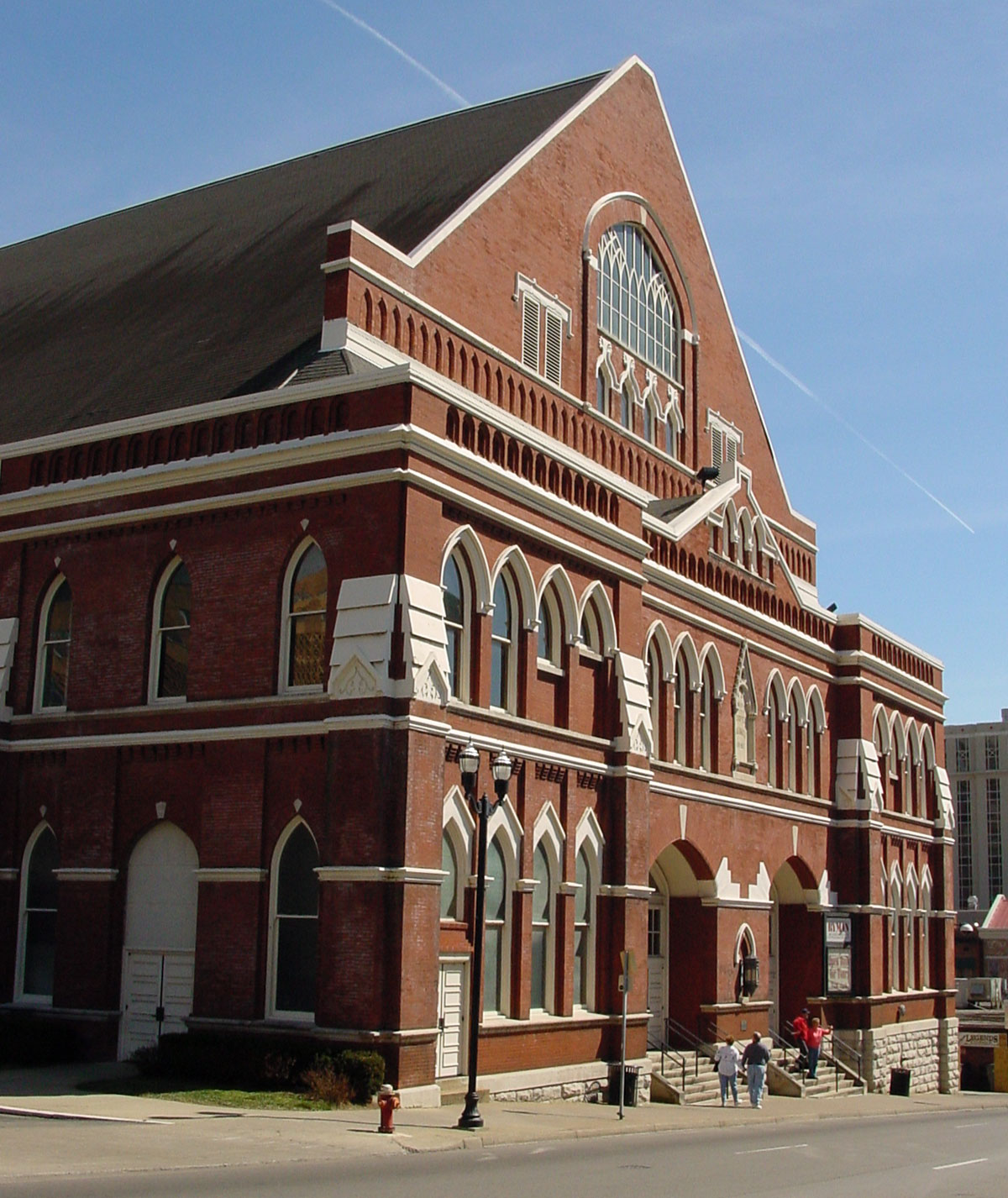
Thomas Ryman ran saloons and a fleet of riverboats on the Cumberland River. In 1885, he showed up to one of revivalist Samuel Porter Jones's tent meetings planning to cause trouble. He left a convert — and resolved to build Jones a proper indoor tabernacle so Nashville didn't have to keep hosting revivals in canvas and mud. That building, which opened in 1892 as the Union Gospel Tabernacle, would spend the next century becoming something Ryman could not have imagined: the gravitational center of American roots music.
The Grand Ole Opry broadcast from here every week from June 5, 1943 to 1974, and the pews that once held revival crowds filled instead with country music fans who came from across the South. Hank Williams played here. Elvis Presley played here in 1954, months after cutting his first record. Johnny Cash in 1956. The building's origins as a house of worship gave it a nickname — "The Mother Church of Country Music" — that turned out to be more accurate than ironic.
What few landmarks carry as plainly is the evidence of their own near-death. By the mid-1970s, with the Opry relocated to a new facility at Opryland, WSM's president Irving Waugh announced plans to demolish the Ryman and salvage its materials for a chapel at an amusement park. The building sat mostly vacant for nearly two decades, the neighborhood around it declining in parallel. It survived through a combination of preservation pressure and stubborn affection — reopening as a full performance venue in 1994 — and was designated a National Historic Landmark in 2001.
Architect Hugh Cathcart Thompson designed the structure with the narrow, vertical proportions of a church. The wooden pews are still there. The sight lines are still imperfect. And the stage is still the same compressed rectangle it has always been — which is part of why performances here feel different. The room doesn't give the performer anywhere to hide.
What to Spot
The original wooden church pews that serve as audience seating — curved, dark-stained, and arranged in the close-set rows of a 19th-century tabernacle rather than a conventional performance venue.
Bonus Finds
- The stained-glass windows that ring the upper walls of the auditorium — installed as part of the original 1892 tabernacle design — casting colored light into a room that was never meant to be a concert hall.
- The balcony, completed in 1897 with funds from the United Confederate Veterans gathered for a national reunion; a plaque installed in 2017 replaced the original 'Confederate Gallery' designation with one reading simply '1892 Ryman Auditorium.'
- The narrow alley on the south side of the building, directly behind the stage — the same passage performers used to slip across to Tootsie's Orchid Lounge during Opry broadcasts because the Ryman had only one men's dressing room and no real backstage.
Share your finds and tag us — @scavtopia.
Sightings
- Coal Miner's Daughter (1980) — the Ryman stage appears as the setting for Loretta Lynn's climactic Grand Ole Opry performance
Plan your visit
Scavtopia turns this place — and any place — into an adventure. Join the waitlist.
Photo: CC0