
Chand Baori
Abhaneri, India
Story
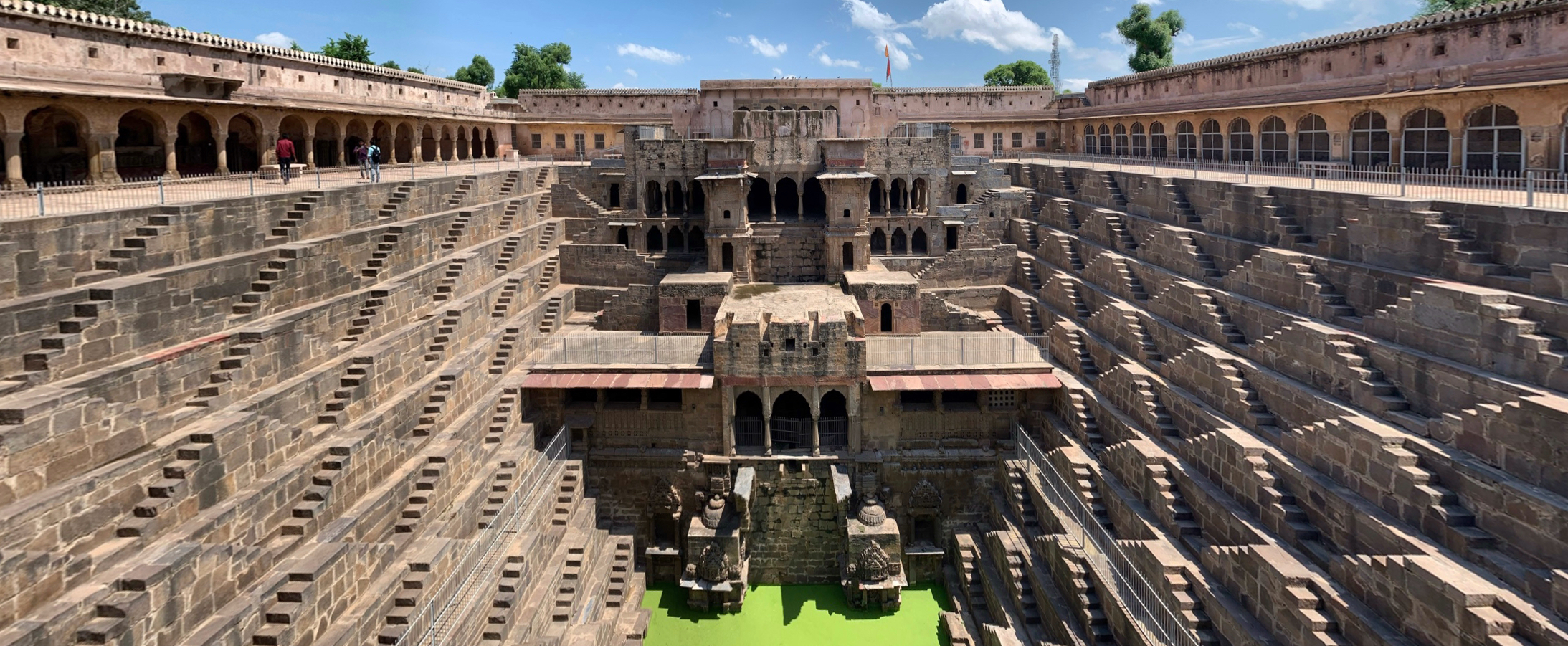
The mind expects a well. What Raja Chanda's craftsmen built in Abhaneri sometime in the 8th or 9th century is closer to an inverted ziggurat — a geometric descent so precise it reads as a single object rather than a construction. Chand Baori plunges roughly 100 feet into the earth across 13 stories, its 3,500 steps arranged in a pattern of interlocking triangles that seem to multiply as you look down. Every tier mirrors the last at a slightly smaller scale, and the cumulative effect is vertiginous: the eye slides toward the dark water at the bottom, then slides back up, unable to settle.
The well served the village of Abhaneri through centuries of Rajasthan's arid heat. Stepwells of this type — vav or baoli in local languages — solved the problem of a dropping water table by building the access structure downward with it, adding tiers as needed. Chand Baori is among the oldest and deepest surviving examples in India. The architects worked in a local sandstone that has since taken on a warm ochre tone, and the geometry they achieved with manual calculation and hand-cut stone has never needed improvement. Later Mughal-era additions are visible in the pavilions and arched galleries along one side — a quieter register against the relentless stairwork opposite.
Standing at the rim, the well works on you slowly. The pattern is too regular to be accidental, too large to absorb at once. It rewards stillness.
What to Spot
The stepped triangular geometry of the north and south walls — when viewed from the rim at the open end — resolves into a near-perfect bilateral mirror image, the two cascading stairways converging symmetrically toward the water tank 100 feet below.
Bonus Finds
- Along the uppermost gallery, small carved niches interrupt the stonework at intervals — sheltered spaces that once held oil lamps to illuminate the descent after dark.
- The Mughal-era pavilions on the eastern side carry a noticeably different architectural register: pointed arched openings and bracketed cornices set against the austere, step-heavy geometry of the original Nikumbh construction.
- At the water level, the tank's surface reflects the inverted pyramid above it on still mornings — the architecture doubling itself in the water it was built to reach.
- A Harshat Mata temple stands immediately adjacent to the stepwell complex; its sculpture fragments, some removed to the Archaeological Museum in Abhaneri, include intricately carved panels dated to the same 8th–9th century period as the well itself.
Share your finds and tag us — @scavtopia.
Sightings
- The Dark Knight Rises (2012) — the stepwell's pit served as the exterior of the prison from which Bruce Wayne must climb free
Plan your visit
Scavtopia turns this place — and any place — into an adventure. Join the waitlist.
Photo: Chainwit. / CC BY-SA 4.0