
Rookery Building
Chicago
Story
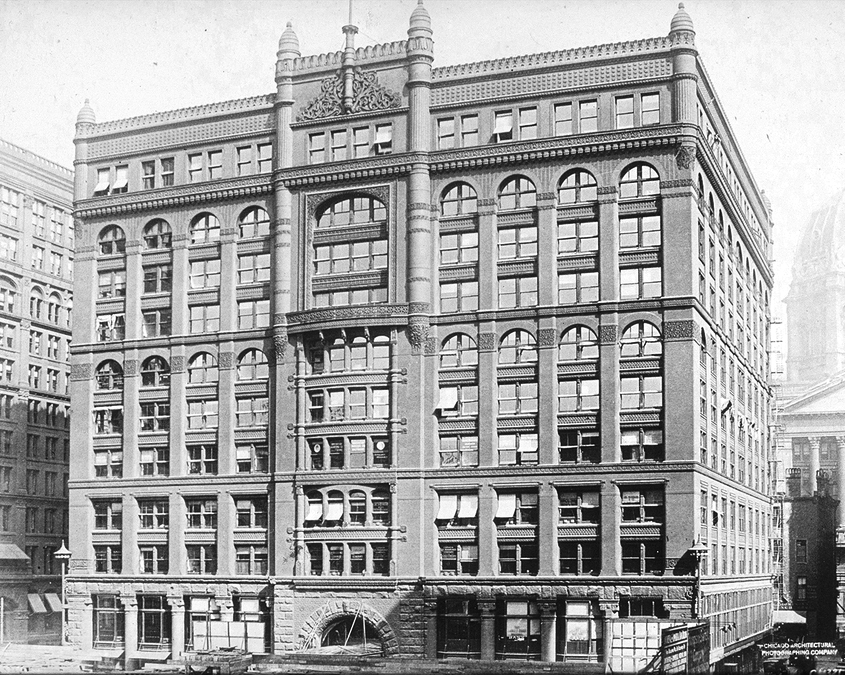
Everyone comes to the Rookery for Frank Lloyd Wright. That's understandable — his 1905 atrium renovation is one of the most photographed interiors in Chicago, all white marble and golden tracery and Prairie-style geometry. But Wright was a latecomer. The building he dressed up had already solved an engineering problem that most architects of the era refused to believe could be solved at all.
When Daniel Burnham and John Wellborn Root began designing the Rookery in 1885, they were building on Chicago's notoriously waterlogged ground — soil that had swallowed foundations and humbled ambitions across the city since before the Great Fire. Root's answer was a grillage foundation: iron rails and structural beams woven into a crisscross grid and encased in concrete, creating a floating raft beneath the building's immense weight. No deep pilings, no bedrock anchor. Just engineering confidence pressed into the earth.
The structure completed in 1888 was a hybrid creature — exterior masonry load-bearing walls paired with an interior skeleton of cast and wrought iron, a transitional moment between two eras of construction. Architectural critic Paul Goldberger later identified it as a direct precursor to the steel-framed skyscrapers that would define Chicago's skyline within a decade. The Rookery is, in other words, a missing link — built at the exact hinge point where masonry yielded to metal.
And then there is the name. The site held a reservoir in 1852, then a temporary city hall after the Great Fire. That improvised building filled with crows and pigeons — and, according to contemporary accounts, with corrupt politicians — earning it the nickname "the Rookery." When Peter Brooks, the Boston investor who commissioned the new building, considered alternatives, the name stuck. The birds carved into the granite near the entrance are a direct memorial to that reputation.
What to Spot
Stone birds carved in relief into the rough-faced red granite near the main entrance on South LaSalle Street — a direct sculptural nod to the crows and pigeons that gave the building its name.
Bonus Finds
- The atrium's skylight is assembled from approximately 5,000 individual glass panes — a fact that becomes almost physical when you stand beneath it and register the scale of what Root and Burnham engineered before Wright ever touched the place.
- At the base of the curving double staircase, a pair of ornamental urns marks where Wright's 1905 renovation meets Burnham and Root's original skeletal metalwork — two design philosophies in close and visible negotiation.
- The South LaSalle Street façade reads as almost severe from the street — rough granite at street level, brick above, the reddish-brown mass giving nothing away about the light court waiting inside.
- A library on the 11th floor originally belonged to Burnham and Root, who kept their own offices in the building they designed — one of the more quietly remarkable facts in Chicago architectural history.
Share your finds and tag us — @scavtopia.
Plan your visit
Scavtopia turns this place — and any place — into an adventure. Join the waitlist.
Photo: Unknown authorUnknown author / Public domain