
Bonaventure Cemetery
Savannah
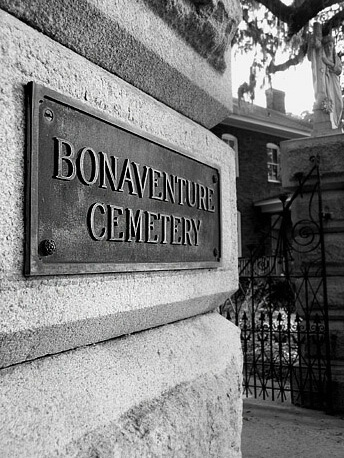
Story
Bonaventure's fame arrived in a single image: Jack Leigh's cover photograph for John Berendt's 1994 book Midnight in the Garden of Good and Evil, a small bronze figure of a girl holding two shallow bowls, Spanish moss bleeding into the sky above her. That sculpture, known as the Bird Girl, stood in Bonaventure for decades before anyone paid it much attention. The book made her iconic overnight. By 1997, the original had to be removed — too many hands, too many flashbulbs — and she now lives at the Jepson Center for the Arts on West York Street.
What Bonaventure gives you instead is something harder to frame but more durable. The cemetery sits on a bluff above the Wilmington River, 160 acres of live oaks draped in Spanish moss so dense that the light arrives filtered, green, and slow. It began as the private burial ground of Bonaventure Plantation, owned originally by Colonel John Mullryne. Commodore Josiah Tattnall III sold the plantation and its cemetery to merchant Peter Wiltberger on March 10, 1846. Wiltberger's son formed the Evergreen Cemetery Company on June 12, 1868; the City of Savannah bought it on July 7, 1907 and renamed it Bonaventure.
In October 1867, before any of that civic history settled in, John Muir spent six days and nights sleeping on the graves here. He was walking to Florida, broke, waiting for money to arrive from home, and he found the place breathtakingly beautiful — writing about it later in a chapter he called "Camping in the Tombs." That a man who would go on to found the American conservation movement lay here among the graves, stunned by moss and oak and river light, feels like the cemetery's real origin story. The famous photograph came much later.
What to Spot
The grave of poet and novelist Conrad Aiken, marked by a wide horizontal bench-style granite slab engraved with a martini glass and the words "Cosmos Mariner — Destination Unknown," designed by Aiken himself before his death in 1973.
Bonus Finds
- The Gaston Tomb stands immediately inside the cemetery gates — a large, ornate monument built in memory of William Gaston, a prominent Savannah merchant, and one of the most architecturally elaborate structures in the entire cemetery.
- Johnny Mercer, the songwriter behind "Moon River" and "That Old Black Magic," is buried here alongside his ancestor Hugh W. Mercer, a Confederate Civil War general — two generations of Savannah fame sharing the same ground.
- The grave of Gracie Watson, who died at age six in 1889, is marked by a life-sized marble statue of the child carved by sculptor John Walz — the stone face worn smooth in places by more than a century of visitors who have left coins, toys, and small offerings at her feet.
- Section K holds the nation's second-largest dedicated burial ground for veterans of the Spanish-American War, from Worth Bagley Camp #10 — an unexpectedly significant piece of military history tucked inside what most visitors experience as a literary landmark.
Share your finds and tag us — @scavtopia.
Sightings
- Midnight in the Garden of Good and Evil (1997) — Clint Eastwood directed this adaptation of Berendt's book, with the cemetery appearing as a setting and its atmosphere central to the story's mood
Plan your visit
Scavtopia turns this place — and any place — into an adventure. Join the waitlist.
Photo: User:Frogwhite (Carmen Cordelia) / Public domain