
Skellig Michael
County Kerry, Ireland
Story
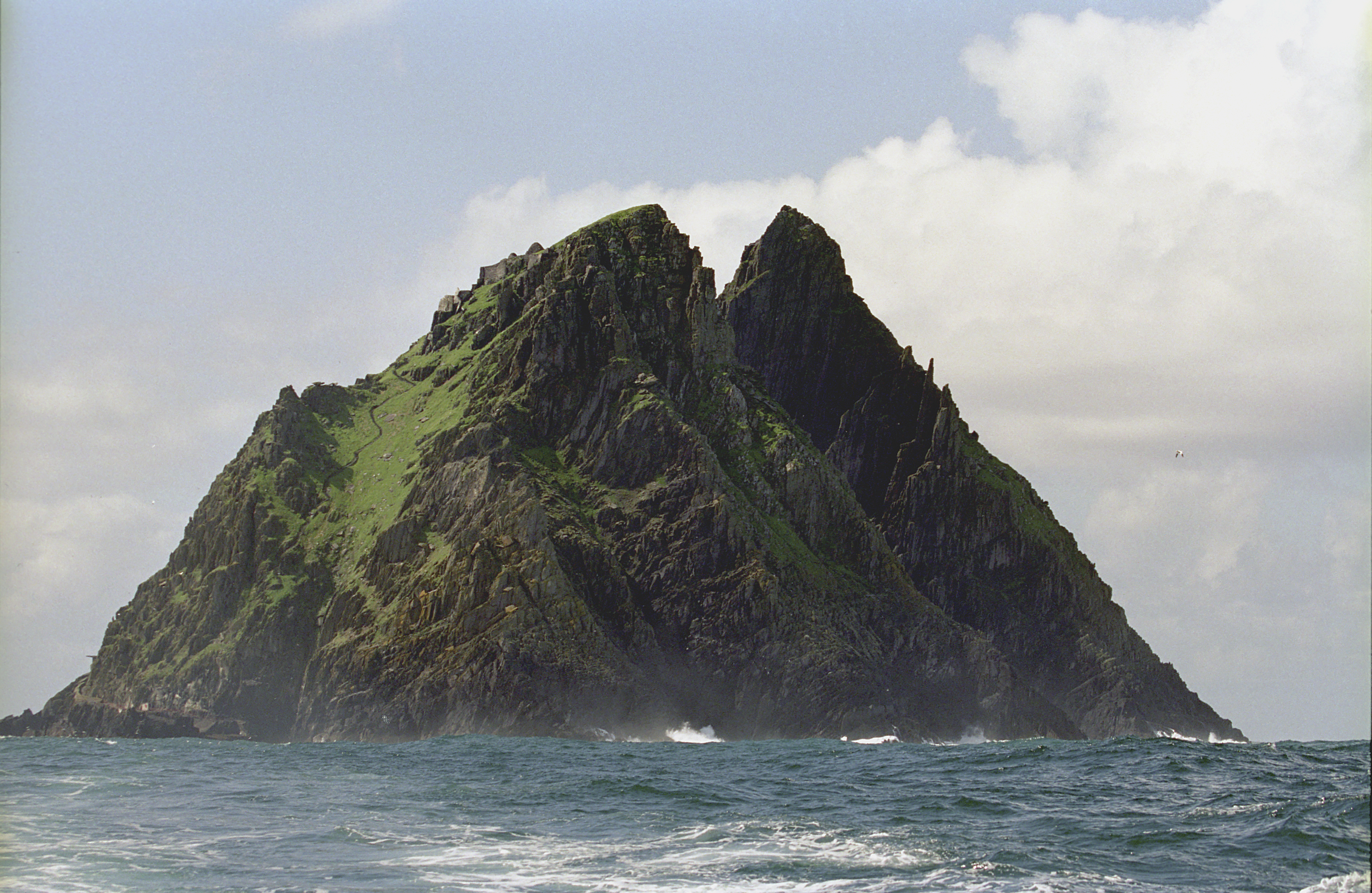
The monastery on Skellig Michael shouldn't exist. A community of early Christian monks — probably arriving sometime in the 6th or 7th century — chose a sea-lashed crag 7.2 miles off the Kerry coast, 600 feet above the Atlantic, and built a world there. Not a rough shelter, but a considered, articulated settlement: six corbelled beehive huts and two oratories, assembled from dry-stacked stone without mortar, shaped so precisely that rain runs off their curved walls and the interiors stayed dry for over a thousand years. The monks called the island Sceilg Mhichíl — the splinter of stone sacred to Michael.
What stops you cold is not the altitude or the exposure, though both are considerable. It's the scale of intention. To reach the monastery, the monks quarried and laid approximately 600 steps directly into the rock face — three separate stairways ascending from the coves below, converging on the settlement like the arms of a slow, stone argument. The steps are still in use. Most of them are original.
The island endured Viking raids in 812 and 823 AD, both recorded in the Annals of Ulster. The community survived and remained until sometime in the 12th century, when the monks finally relocated to Ballinskelligs on the mainland. No one is certain what drove the departure — climatic deterioration is the leading theory. What they left behind calcified into near-perfect preservation: the cold, the salt air, and the island's sheer inaccessibility conspiring to protect what centuries of ordinary exposure would have destroyed. UNESCO inscribed it as a World Heritage Site in 1996, though the place had been making its own case for that status since roughly 588 AD.
What to Spot
The corbelled roofs of the six beehive huts (clocháns) visible from Christ's Saddle — each one a rounded stone dome built without mortar, their overlapping courses tightening inward to a sealed apex, structurally unchanged since the early medieval period.
Bonus Finds
- The Needle's Eye — a narrow stone chimney approximately 490 feet above sea level on the south peak — is a geological feature formed by erosion along a brittle fault line, not a human construction, yet it stands like a punctuation mark above the Way of the Christ path.
- Little Skellig, visible from the island's eastern coves, is entirely white in summer — not painted, but covered by one of Europe's largest northern gannet colonies, estimated at over 30,000 breeding pairs.
- At the Wailing Woman rock near Christ's Saddle, a small area of flattened grassland marks the only fertile patch on the island; faint traces of medieval cultivation ridges are still readable in the soil here.
- The 14 stone crosses along the south peak ascent carry names — including the 'Rock of the Women's Piercing Caoine' — that suggest a penitential pilgrimage route used long after the monks departed in the 12th century.
Share your finds and tag us — @scavtopia.
Sightings
- Star Wars: The Force Awakens (2015) — the monastery steps and summit served as the filming location for Ahch-To, the island retreat of Luke Skywalker in the final scene
- Star Wars: The Last Jedi (2017) — location shooting returned to Skellig Michael for additional Ahch-To sequences, with the beehive huts visible as Luke's dwelling
Plan your visit
Scavtopia turns this place — and any place — into an adventure. Join the waitlist.
Photo: Jerzy Strzelecki / CC BY-SA 3.0