
Galleria Vittorio Emanuele II
Milan, Italy
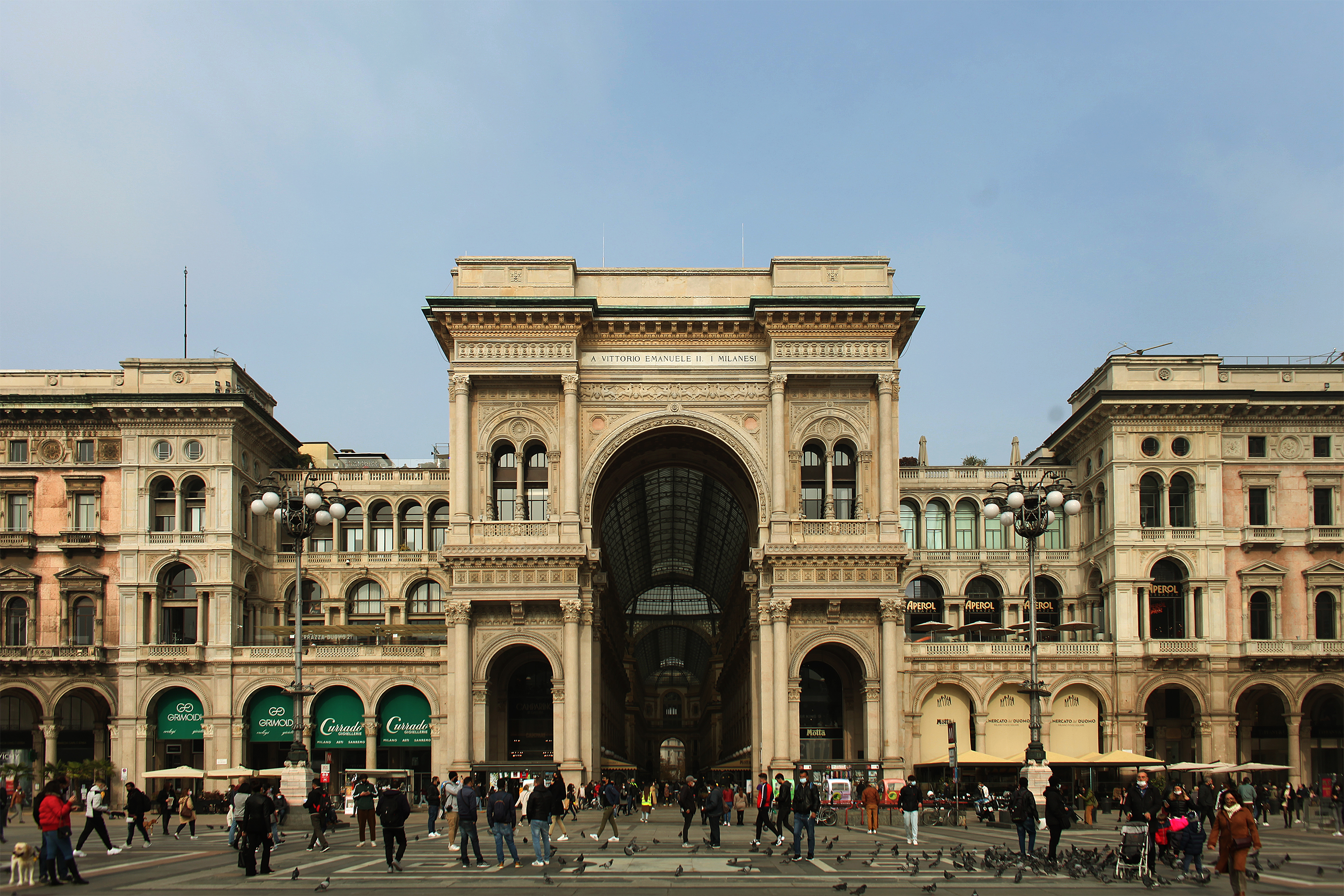
Story
In the central octagon of the Galleria Vittorio Emanuele II, four mosaic medallions mark the coats of arms of the Kingdom of Italy's capitals — Turin, Florence, Rome, and Milan itself. Turin's medallion includes a charging bull, and for well over a century, Milanese tradition has held that spinning three times on one heel pressed into the bull's testicles brings good luck. The ritual has been performed so relentlessly that the marble has worn through entirely, leaving a shallow crater where the genitals once were. The city repaired it. The spinning continued. The hole came back.
Giuseppe Mengoni designed the Galleria in 1861, and construction ran from 1865 to 1877 — twelve years of ironwork, glass, and ambition on a scale that outpaced every covered arcade before it. The ironwork came from the Atelier Henry Joret in France; the glass plates from Saint-Gobain. The four barrel vaults, each roughly 47 feet wide and 28 feet tall, converge at a dome stretching nearly 123 feet across. Critics Pevsner and Hitchcock later acknowledged the roof as a benchmark of 19th-century iron-and-glass construction. Mengoni himself did not survive to see the inauguration — he fell from the scaffolding just days before the opening ceremony in 1877.
The Galleria was bombed heavily during World War II and has been repaired and conserved multiple times since. A major cleaning ahead of Expo Milano 2015 used a moving crane scaffold to reach the facades, mosaics, and statues without a single fixed support touching the floor below. The result is a space that reads as both ancient and implausibly light — a glass cathedral that somehow doubled as a shortcut between the Duomo and La Scala.
What to Spot
The worn crater in the Turin bull mosaic at the center of the octagonal floor — a shallow depression where the bull's genitals have been ground away by millions of heel-spins, repaired, and eroded again.
Bonus Finds
- Each of the four barrel vaults ends in a small lantern — easy to miss from ground level, but visible at the junction where vault meets wall, letting additional light bleed into the arcade at four separate points beyond the main dome.
- Camparino in Galleria, at the Duomo-end entrance, retains its original Art Nouveau interior from the early 20th century — mosaic tiling, curved wood, and fittings that have outlasted everything around them.
- Biffi Caffè, founded in 1867 by Paolo Biffi — pastry chef to King Victor Emmanuel II — operated inside the Galleria almost from the day it opened, making it one of the few businesses continuous with the building's original commercial life.
- The four coats of arms in the octagon form a quiet history lesson underfoot: three capitals the Kingdom of Italy cycled through before settling on Rome, plus Milan, which never held the title but anchored the Galleria that bears the king's name.
Share your finds and tag us — @scavtopia.
Plan your visit
Scavtopia turns this place — and any place — into an adventure. Join the waitlist.
Photo: Paolobon140 / CC BY-SA 4.0