
Bradbury Building
Los Angeles
Story
George Wyman had no architectural training. In 1892 he was a draftsman earning $5 a week for Sumner Hunt when Lewis Bradbury — a gold-mining millionaire who had already rejected Hunt's completed design as too modest — came to him directly. Wyman initially declined. According to a story that has circulated for over a century, his deceased brother communicated through a planchette, urging him to accept: "George, take the Bradbury building and you will be successful." He took it. The building opened in 1893, months after Bradbury himself died, and came in at $500,000 — three times the original budget of $175,000.
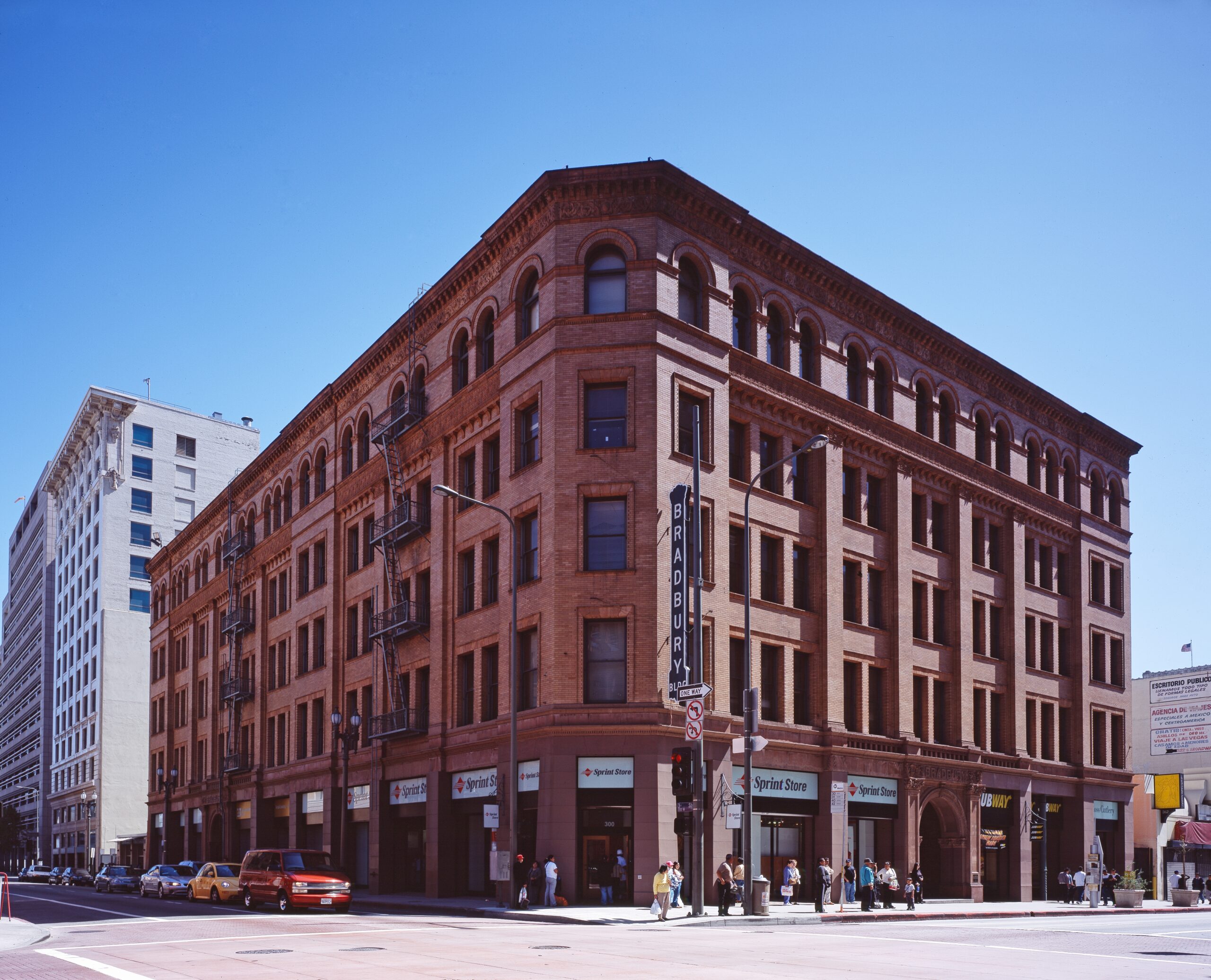
What Wyman built from Hunt's discarded plans is one of the great spatial surprises in American architecture. The Broadway façade is almost aggressively plain — brown brick, sandstone, restrained terracotta, and nothing to suggest what waits inside. Then the narrow entrance lobby opens, and the atrium unfolds: five stories of ornamental cast iron, glazed yellow and pink brick, Mexican tile, Italian marble, and polished oak railings climbing to a vast glass skylight. The ironwork was fabricated in France from designs exhibited at the 1893 Chicago World's Fair. Natural light pours through the roof and shifts across the grillwork all day, throwing geometric shadows that never repeat.
The building has been an LAPD Internal Affairs headquarters since 1996 — officers call it "the Ovens" — and casual visitors are limited to the first landing. That turns out to be enough. The bilateral symmetry of the atrium is fully legible from ground level, the open birdcage elevators still run, and Wyman's improbable achievement still reads exactly as it did when the Los Angeles Times described it: "a mesmerizing degree of symmetry and visual complexity."
What to Spot
The cast-iron birdcage elevators on the atrium floor — open-grille cars wrapped in wrought-iron scrollwork, their shafts rising through all five stories against the glazed brick walls.
Bonus Finds
- The South Broadway exterior offers almost no hint of what's inside — the brown brick and sandstone façade is so restrained it reads as a background building, which makes the interior a genuine rupture.
- The atrium's bilateral symmetry becomes apparent from the entrance: the two ornate staircases, railings, and ironwork galleries mirror each other almost exactly across the central court — a degree of precision unusual for a building designed by someone with no formal architectural training.
- Ross Cutlery has occupied a first-floor retail space for decades, one of the few surviving knife shops in downtown Los Angeles — a quiet anachronism wedged into a landmark. [FLAG FOR HUMAN FACT-CHECK: research text states O.J. Simpson purchased a stiletto here that figured in his murder trial — verify before publishing.]
- The skylight structure overhead is not decorative glass but a functional industrial roof — iron framing and clear panels that flood the court with natural light and cast shadows that shift visibly across the ironwork throughout the day.
Share your finds and tag us — @scavtopia.
Sightings
- D.O.A. (1950) — the building appears in this noir thriller, one of several 1940s–50s noir productions that used the atrium as a location
- Blade Runner (1982) — the atrium stands in for J. F. Sebastian's apartment building, and the climactic rooftop confrontation takes place here
Plan your visit
Scavtopia turns this place — and any place — into an adventure. Join the waitlist.
Photo: Carol M. Highsmith / Public domain