
Grand Central Terminal
New York City
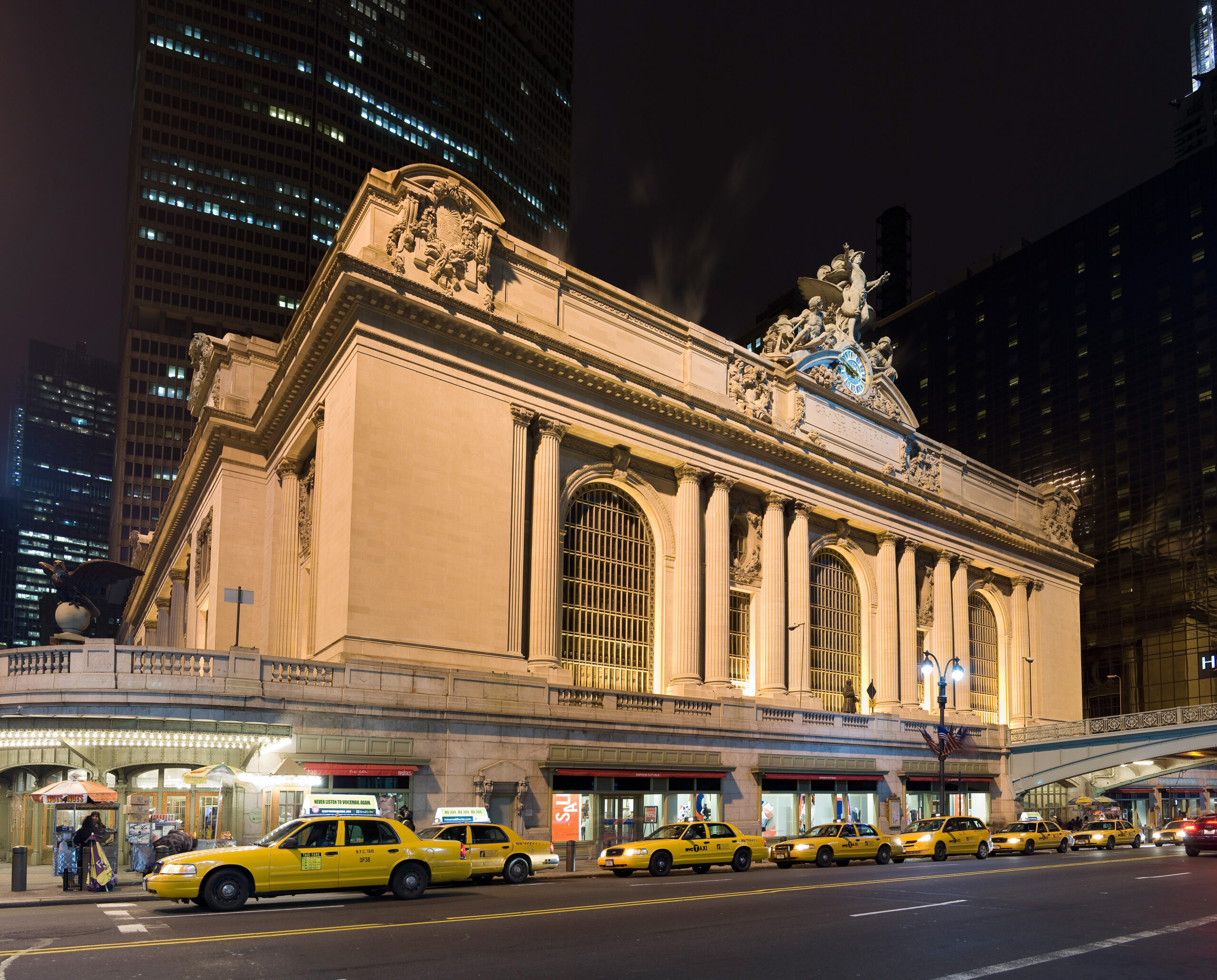
Story
Most people who pass through Grand Central Terminal look up — at the famous turquoise ceiling of the Main Concourse, its constellation mural stretching across 12,000 square feet of vaulted sky. What almost nobody notices is that the sky is backwards. The stars are painted as a mirror image of the actual night sky, with east and west reversed. Astronomers pointed this out not long after the terminal opened in 1913, and the response from the New York Central Railroad was essentially a shrug: the ceiling depicts the medieval manuscript from which the design was drawn, not the sky as you'd see it standing on Earth.
The terminal itself opened on February 2, 1913, replacing two earlier stations on the same site, the first dating to 1871. The architect Warren and Wetmore drove the Beaux-Arts design, though the interior circulation system — ramps instead of stairs, split-level platforms — came from engineers Reed and Stem, and from New York Central vice president William J. Wilgus, who conceived the radical idea of sinking all tracks underground to unlock the real estate above. That decision shaped Midtown Manhattan for the next century.
By the 1960s, the terminal faced demolition. Penn Station had just been torn down in 1963, and Grand Central was next in the crosshairs of developer Morris Lapidus and others. Jacqueline Kennedy Onassis became the most visible face of the preservation campaign, and in 1978, the U.S. Supreme Court upheld New York City's landmark protections in a decision that effectively saved the building. A $200 million restoration completed in 1998 stripped decades of grime from the ceiling, revealing the constellation mural's original viridian and gold — and confirming, once again, that the stars are still facing the wrong way.
What to Spot
The turquoise constellation mural covering the arched ceiling of the Main Concourse, where Orion, Aquarius, and the surrounding zodiac figures are painted as a reversed mirror image — east and west transposed — of the actual night sky.
Bonus Finds
- At the center of the Main Concourse floor sits the information booth with its four-sided brass clock — opal faces, no visible mechanism, and a quiet status as one of the most-photographed objects in New York.
- The Graybar Passage, running east from the terminal through the 1926 Graybar Building, has seven groin-vaulted ceiling bays, each with an ornamental bronze chandelier, and travertine walls that most commuters walk past without registering.
- During morning rush hour a train arrives at Grand Central every 58 seconds — and the lower level, largely invisible to casual visitors, holds 26 additional tracks beneath the ones most people ever see.
Share your finds and tag us — @scavtopia.
Sightings
- The Fisher King (1991) — Terry Gilliam staged the film's most famous sequence — hundreds of commuters waltzing spontaneously in the Main Concourse — inside the terminal itself.
- The Avengers (2012) — The Chitauri invasion sequence uses Grand Central's Vanderbilt Avenue exterior and surroundings as a recognizable anchor for the film's climactic battle in Midtown.
Plan your visit
Scavtopia turns this place — and any place — into an adventure. Join the waitlist.
Photo: Fcb981 ; Eric Baetscher/ CC BY-SA 3.0